JPEDLAB iconJPEDLAB
Save history

Create an account and play

Explore first, then save your progress whenever you are ready. No email address is required.

Start free
Read as articleCards
See the whole course›Beginner 2›Introducing Your Life

Japanese grammar · ≈ JLPT N5 · Beginner 2

普通形futsuu kei

casual plain speech forms

Use 「普通形」 with friends or family; verbs, adjectives, and nouns each change endings for tense and negation.

Start the interactive lessonIllustrated cards, audio and speaking practiceTake the quiz
Pattern
普通形
Romaji
futsuu kei
JLPT (approx.)
≈ N5
Course level
Beginner 2
Theme
Introducing Your Life

How it works

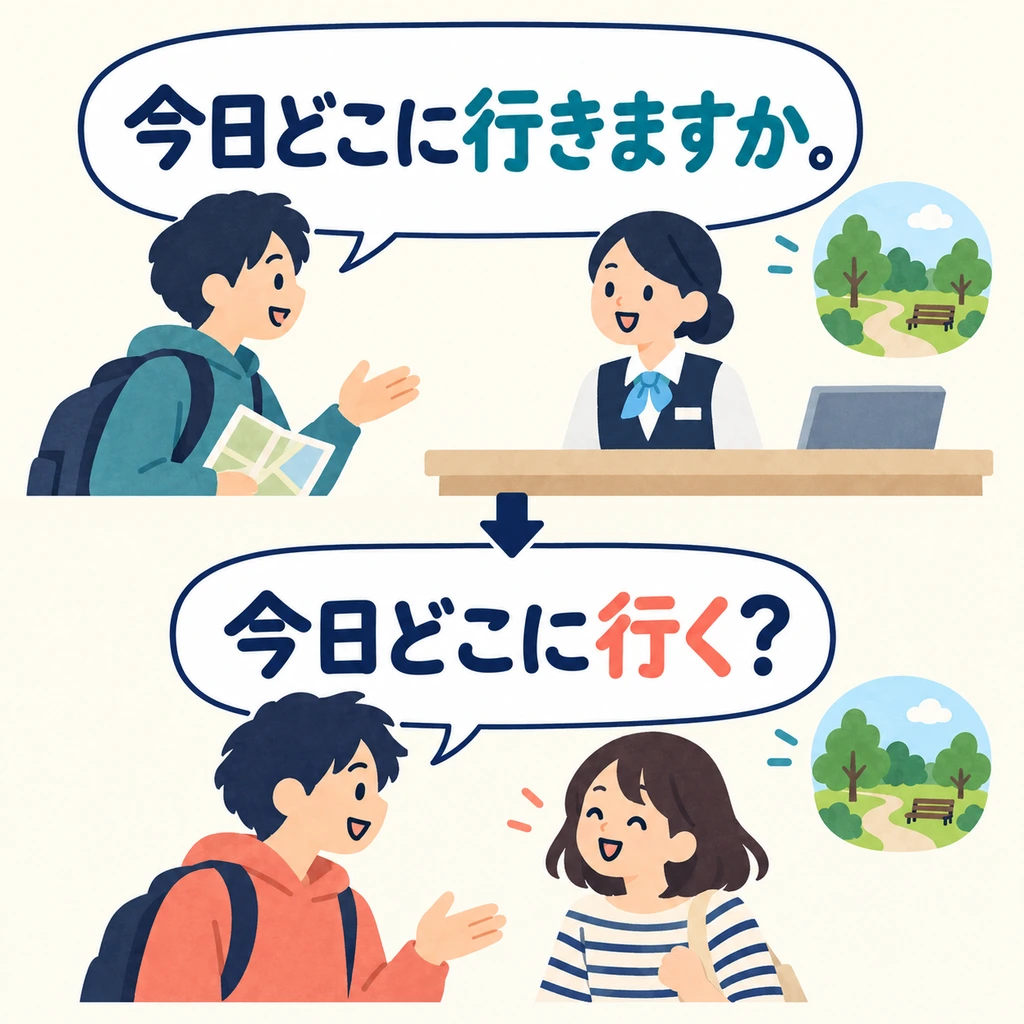
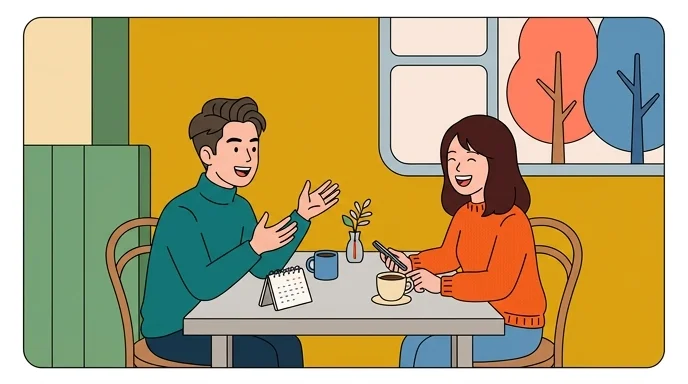
  1. When talking with friends, family, or others you are close to, you often use the plain form for a casual tone.
    When talking with friends, family, or others you are close to, you often use the plain form for a casual tone.

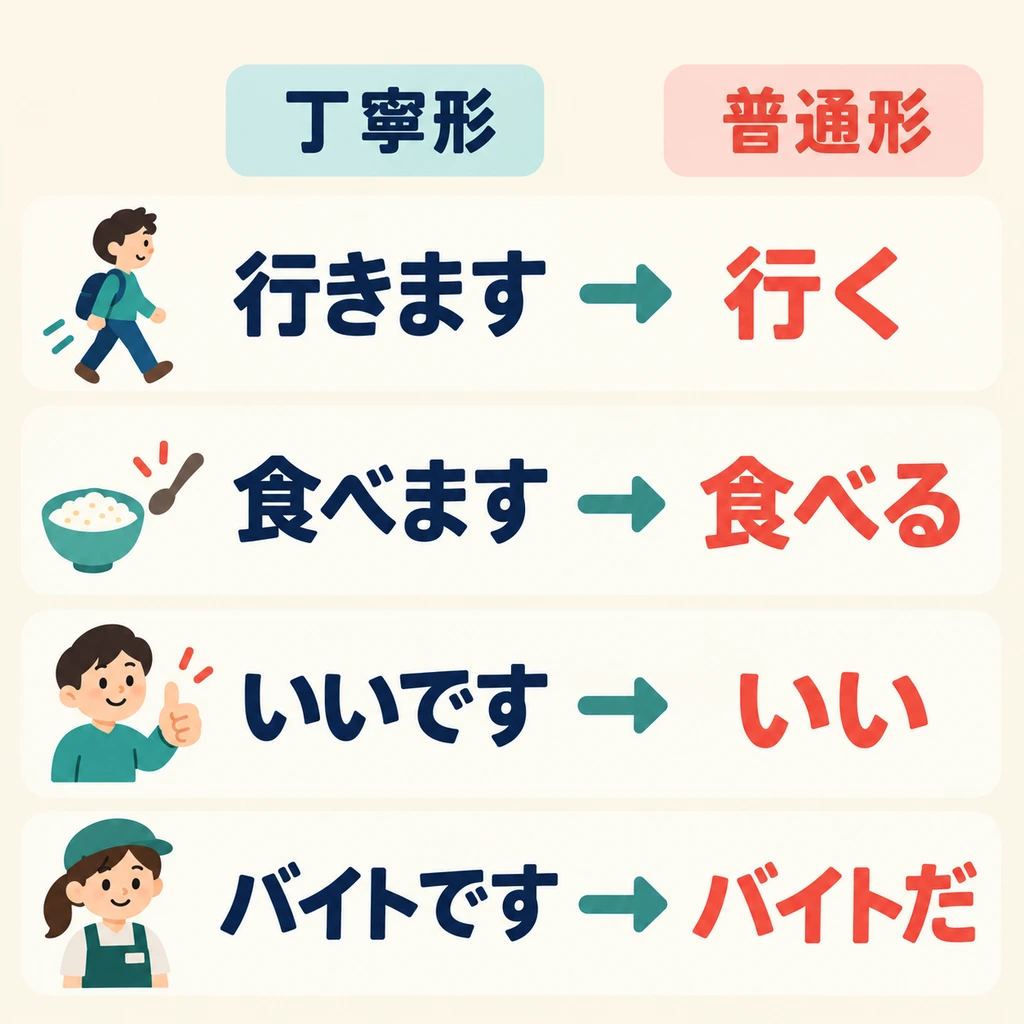
  2. Look at the right column: plain-form endings vary by word type. You cannot simply remove 「ます」 in every case.
    Look at the right column: plain-form endings vary by word type. You cannot simply remove 「ます」 in every case.

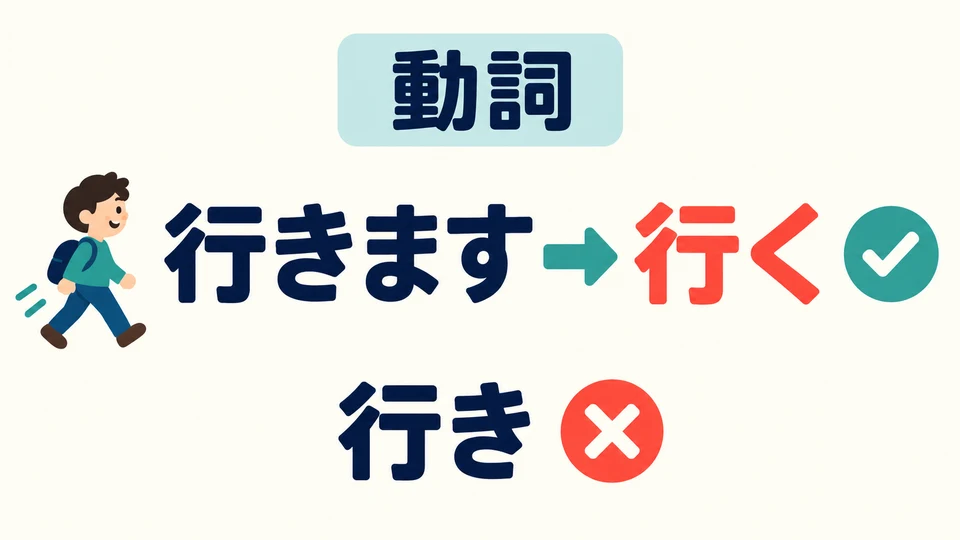
  3. For affirmative verbs in the present, use the dictionary form: 「行きます」 becomes 「行く」, not 「行き」.
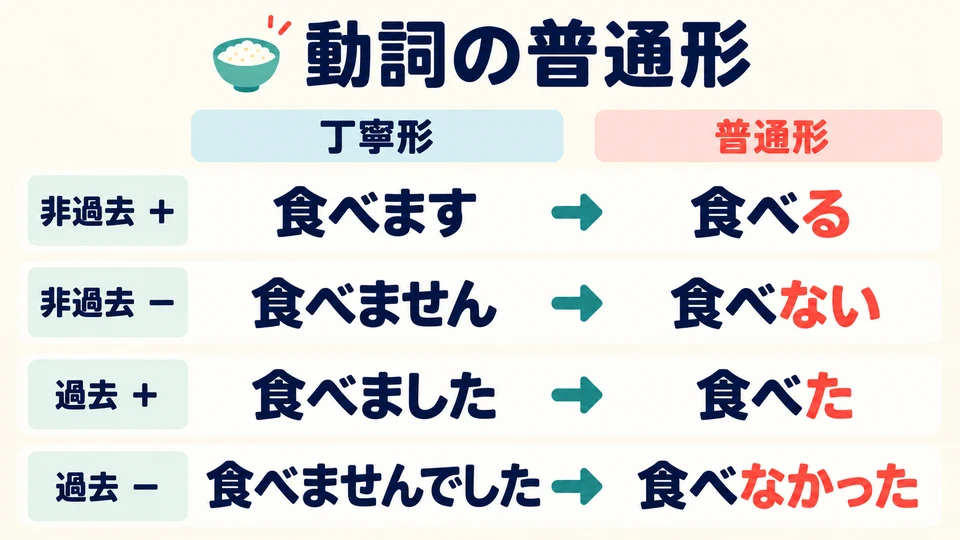
    For affirmative verbs in the present, use the dictionary form: 「行きます」 becomes 「行く」, not 「行き」.

  4. Verbs have four plain forms: non-past/past and affirmative/negative. Keep the tense and polarity when changing forms; the past negative changes ない to なかった.
    Verbs have four plain forms: non-past/past and affirmative/negative. Keep the tense and polarity when changing forms; the past negative changes ない to なかった.

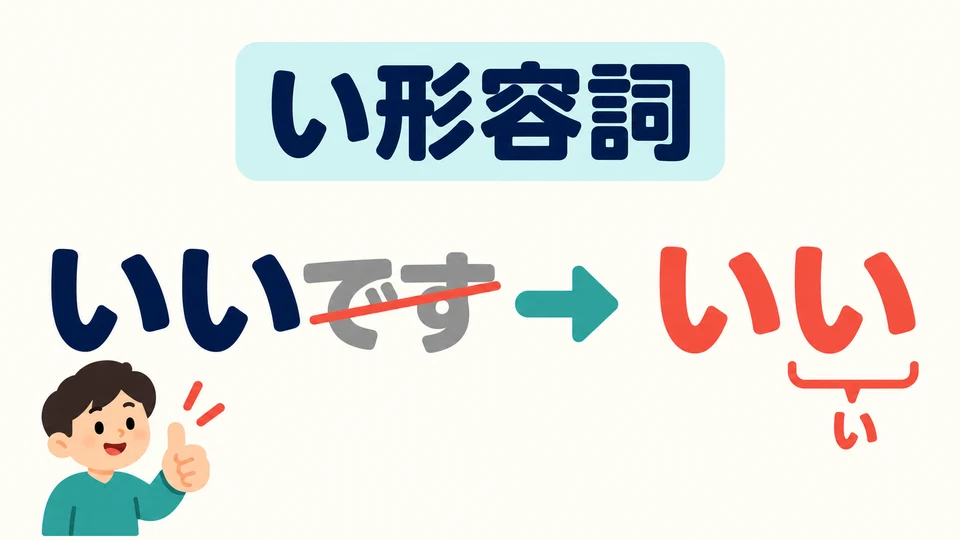
  5. For affirmative い-adjectives in the present, remove 「です」 and keep the final 「い」: いいです→いい.
    For affirmative い-adjectives in the present, remove 「です」 and keep the final 「い」: いいです→いい.

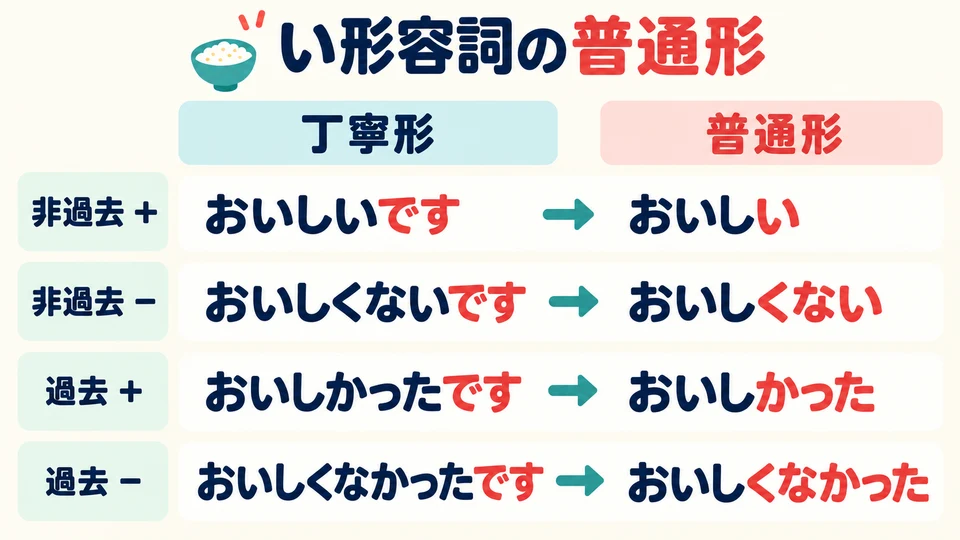
  6. Plain forms of い-adjectives use neither です nor だ. Ending changes express negation and the past; keep the original tense and polarity when changing forms.
    Plain forms of い-adjectives use neither です nor だ. Ending changes express negation and the past; keep the original tense and polarity when changing forms.

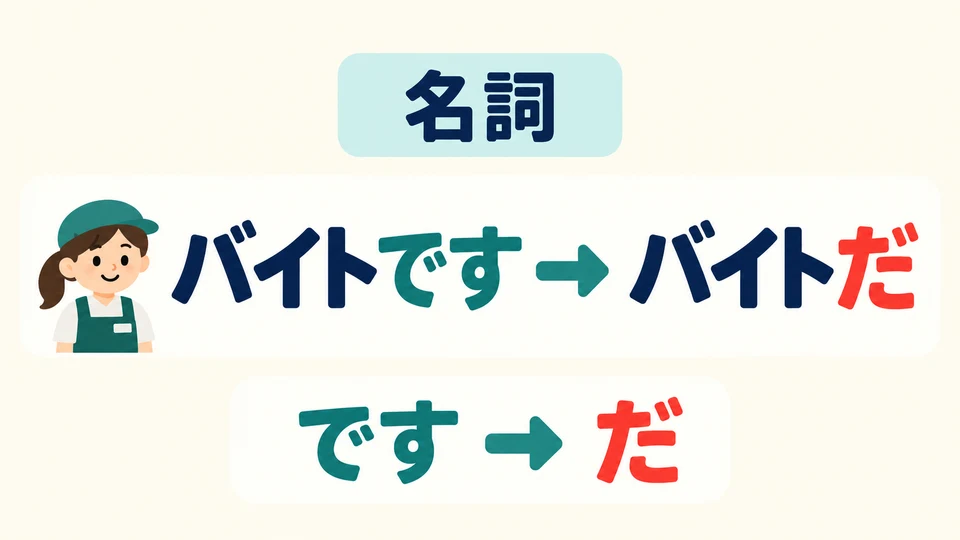
  7. For affirmative noun sentences in the present, replace 「です」 with 「だ」: バイトです→バイトだ.
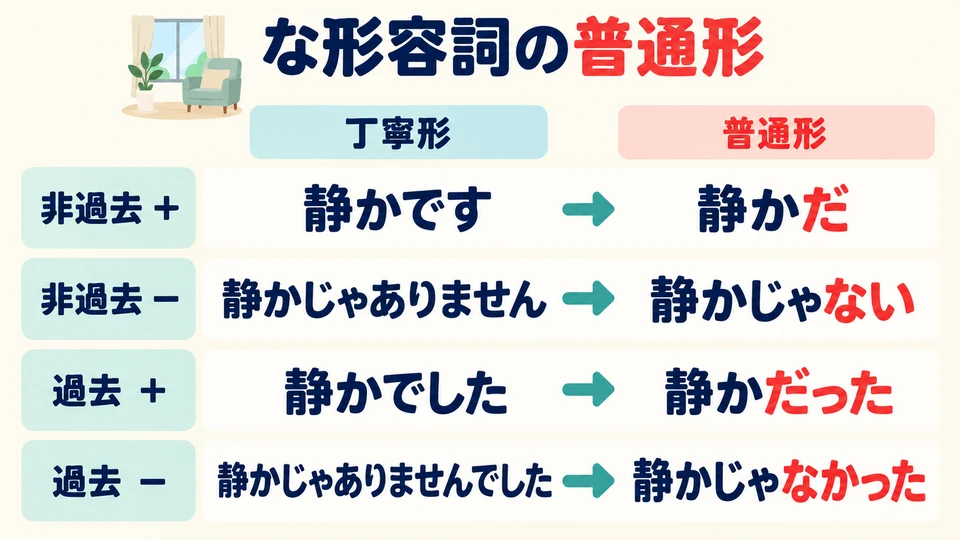
    For affirmative noun sentences in the present, replace 「です」 with 「だ」: バイトです→バイトだ.

  8. The stem of a な-adjective stays unchanged; change the sentence ending to make the four plain forms. In conversation, じゃない and じゃなかった are common negative forms.
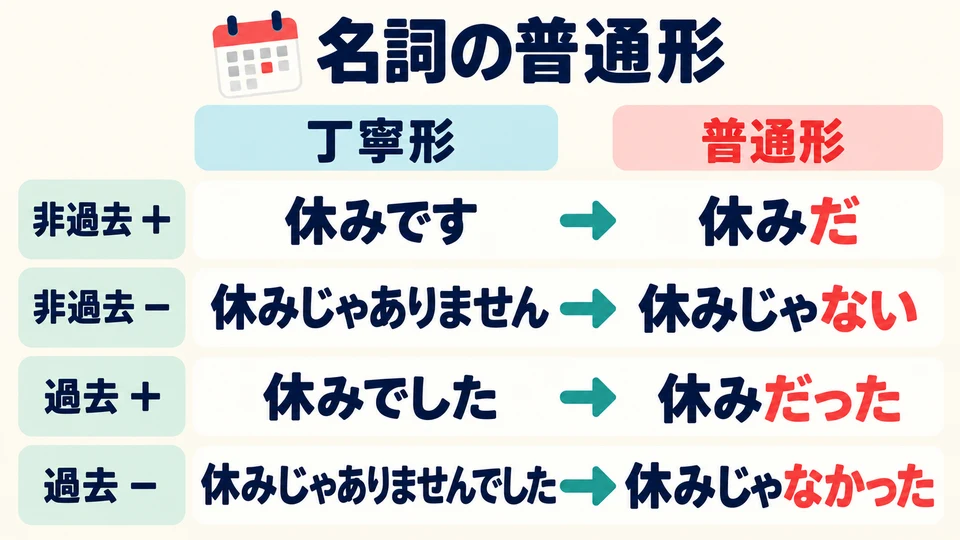
    The stem of a な-adjective stays unchanged; change the sentence ending to make the four plain forms. In conversation, じゃない and じゃなかった are common negative forms.

  9. Nouns and な-adjectives use the same sentence endings. だ, だった, and the negative forms distinguish the four plain forms. The past negative cannot use just じゃない.
    Nouns and な-adjectives use the same sentence endings. だ, だった, and the negative forms distinguish the four plain forms. The past negative cannot use just じゃない.

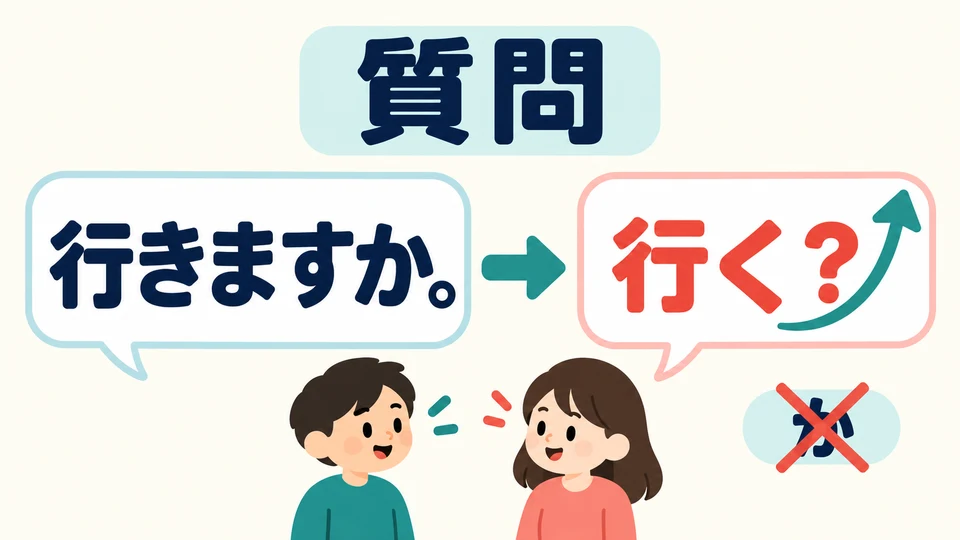
  10. Questions in plain style often omit 「か」. Raise your pitch at the end so the listener hears that you are asking a question.
    Questions in plain style often omit 「か」. Raise your pitch at the end so the listener hears that you are asking a question.

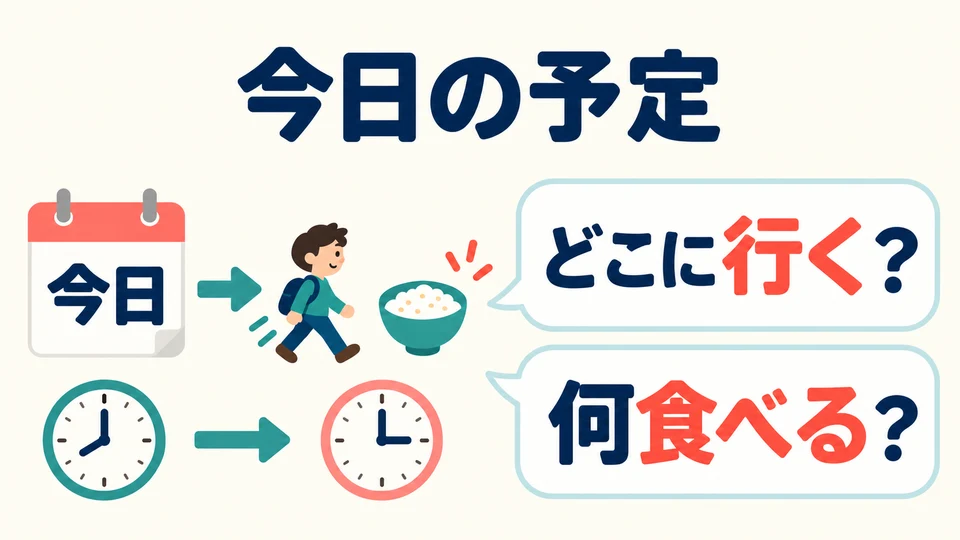
  11. In the example, 「行く?」 and 「食べる?」 ask about today’s plans. The dictionary form can also refer to the future.
    In the example, 「行く?」 and 「食べる?」 ask about today’s plans. The dictionary form can also refer to the future.

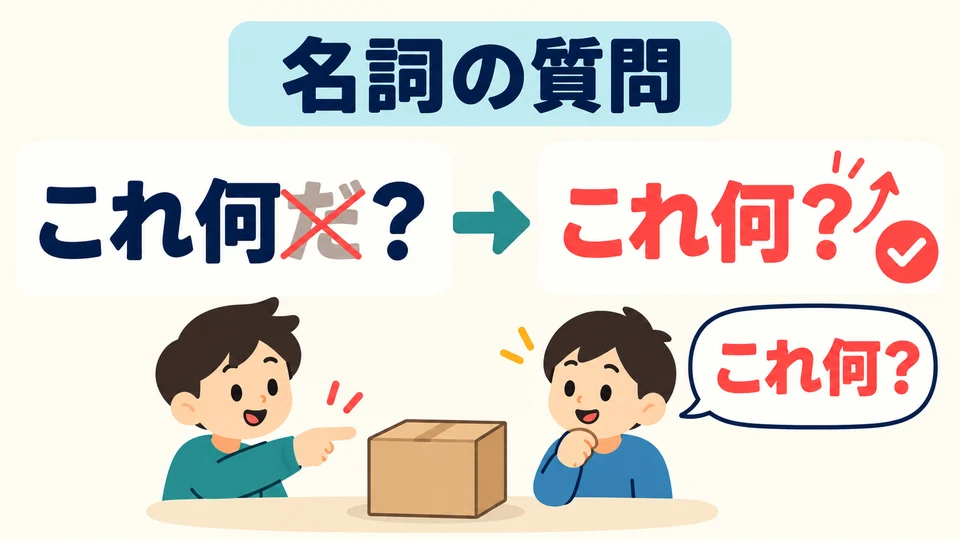
  12. In 「これ何?」, the example omits 「だ」 in a noun question. This is a natural way to ask a friend.

    In 「これ何?」, the example omits 「だ」 in a noun question. This is a natural way to ask a friend.

Example sentences

  • 今日きょうkyouどこdokoにni行く?いくiku何なにnani食べる?たべるtaberu

    Where are you going today? What are you going to eat?

  • これkore何?なんnan

In a conversation

  • A
    ねえ、ねえ明日あす何なにする?する

    A: Hey, what are you doing tomorrow?

  • B
    明日あすはわバイトばいとなんだ。午後だごごは?わ

    B: I have a part-time job tomorrow. How about the afternoon?

Check yourself

  1. Which sentence is correct?

    1. 明日、どこで会う?
    2. 明日、どこで会うす?
    3. 明日、どこで会うを?
    4. 明日、どこで会うに?
    Show answer

    Answer: A 明日、どこで会う?

  2. Which sentence is correct?

    1. 昼ごはん、何にする?
    2. 昼ごはん、何にするを?
    3. 昼ごはん、何にするな?
    4. 昼ごはん、何にするに?
    Show answer

    Answer: A 昼ごはん、何にする?

  3. Which sentence is correct?

    1. このアプリ、どうやって使うの?
    2. このアプリ、どうやって使うのさ?
    3. このアプリ、どうやって使うのを?
    4. このアプリ、どうやって使うのま?
    Show answer

    Answer: A このアプリ、どうやって使うの?

More grammar in this theme

  • 普通形casual plain speech forms

Keep practising

Test your Japanese vocabulary12 adaptive questions, freeCheck your pronunciationRead aloud and get a scorePractise verb forms10-question conjugation quizSee the whole courseGrammar, vocabulary and quizzes by theme

What is this?

A
私わたしもバイト。ばいと夜よるなら空いてるならあいてるよ。よ

A: I have a part-time job too. I'm free in the evening.

  • B
    じゃあ、じゃあ晩ごはんばんごはん一緒いっしょに食べない?たべない

    B: Well then, why don't we have dinner together?

  • A
    いいね!ねどこに行く?いく

    A: Sounds good! Where shall we go?

  • B
    新しいあたらしいラーメン屋、らーめんや行っいってみない?みない

    B: Why don't we try the new ramen shop?

  • A
    行こう!いこう何時なんじに会う?あう

    A: Let's go! What time shall we meet?

  • Take the quiz
    〜は〜ですが、〜は〜ですcontrasting two topics
    〜ていますrepeated everyday habit
    〜たり、〜たりしますlisting example activities
    〜のとき、〜ましたsomething done at that time
    〜てcasual request or invitation
    Previous〜のとき、〜ました
    Next〜て