
Japanese grammar · ≈ JLPT N3 · Intermediate 3
〜つもりだ~ tsumori da
intend to; believe one did
With 〜つもりだ, a dictionary-form verb expresses an intention, while a た-form verb expresses what you believe you have done.
How it works

Planning to call this afternoon; the call has not happened yet. The dictionary form + 「つもり」 expresses your intention.

The person believes they have prepared their ID. The た-form + 「つもり」 expresses what you believe you have done.

Look at the picture: is the ID really in the bag? 「用意したつもり」 only expresses what the person believes; reality may differ.
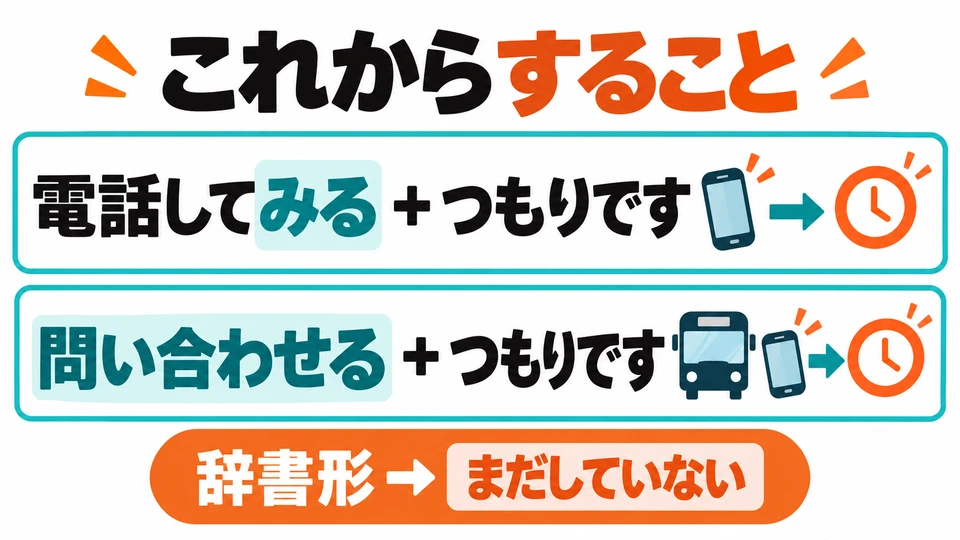
In the examples, 「みる」 and 「問い合わせる」 are both dictionary forms. They show an intention to act; the actions have not happened yet.
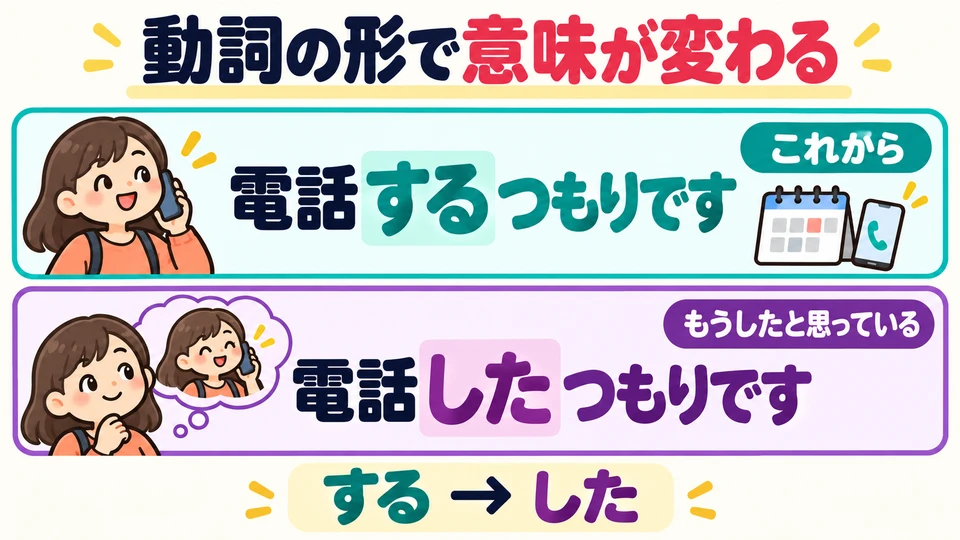
Changing it to 「電話したつもり」 means you believe you have already called. Pay attention to the verb form before 「つもり」.
Example sentences
- 忘れ物wasuremonoセンターsentaaにni電話denwaしshiてteみるmiruつもりtsumoriです。desu。
I plan to try calling the lost and found center.
In a conversation

- A忘れ物センターに問い合わせるつもりですか。
A: Do you plan to contact the lost and found center?
- Bはい、今日の午後に電話
Check yourself
Level 1 · Recognise
Which sentence is correct?
Level 1 · Recognise
Listen and choose the meaning
Level 2 · Build
Put the words in order
I plan to try calling the lost-and-found center.
Level 3 · Use
What goes in the blank?
忘れ物センターに電話してみる____。
I plan to try calling the lost and found center.
More grammar in this theme
- 〜つもりだintend to; believe one did