JPEdLab iconJPEdLab
Save history

Create an account and play

Explore first, then save your progress whenever you are ready. No email address is required.

Start free
  1. Japanese grammar
  2. JLPT N4 grammar
  3. 〜ように、〜

〜ように、〜~you ni, ~

You ni, (〜ように、〜) means “action toward a desired result”.

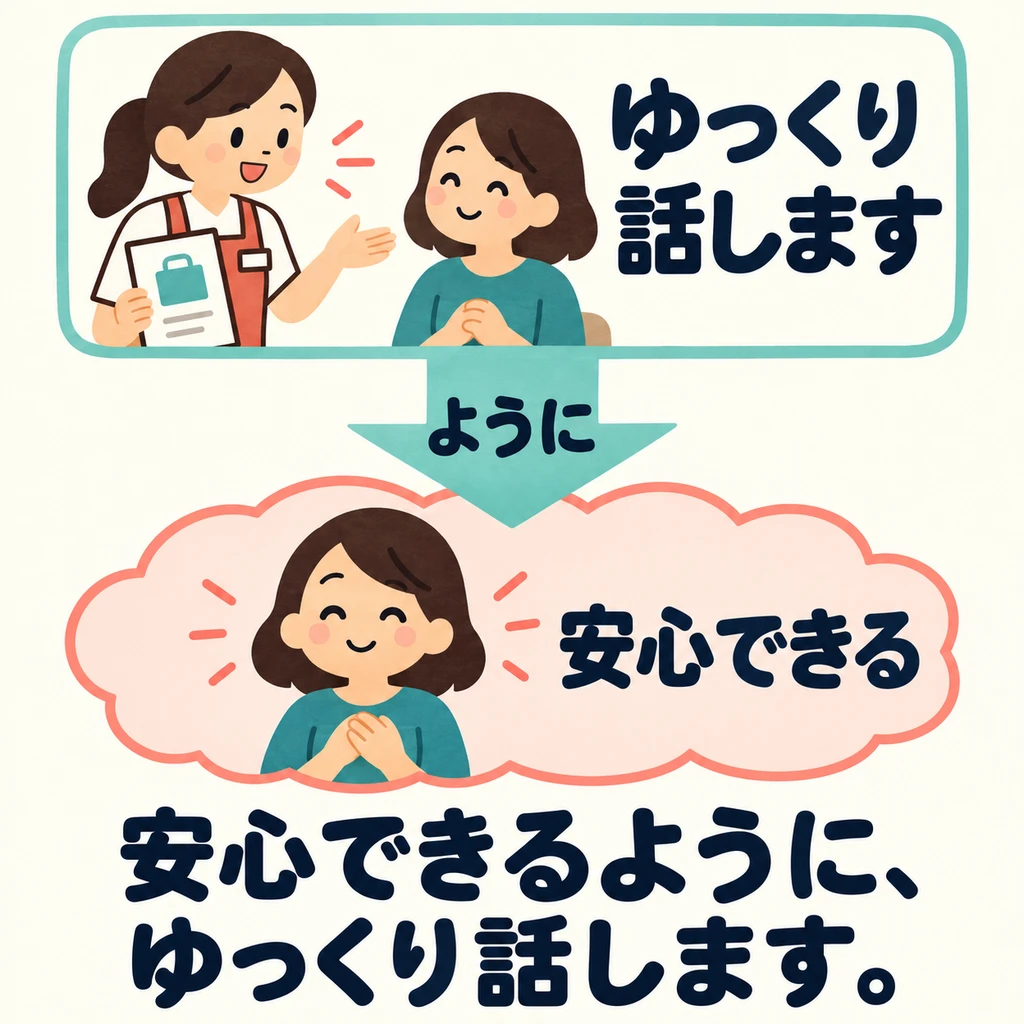
お客様おきゃくさまokyakusamaがga安心あんしんanshinできるdekiruように、ようにyouniゆっくりyukkuri話します。はなしますhanashimasu

So that customers feel at ease, I'll speak slowly.

Put a desired state before 「〜ように」 and the action taken toward it after, including actions to prevent something.

In the course›

How it works

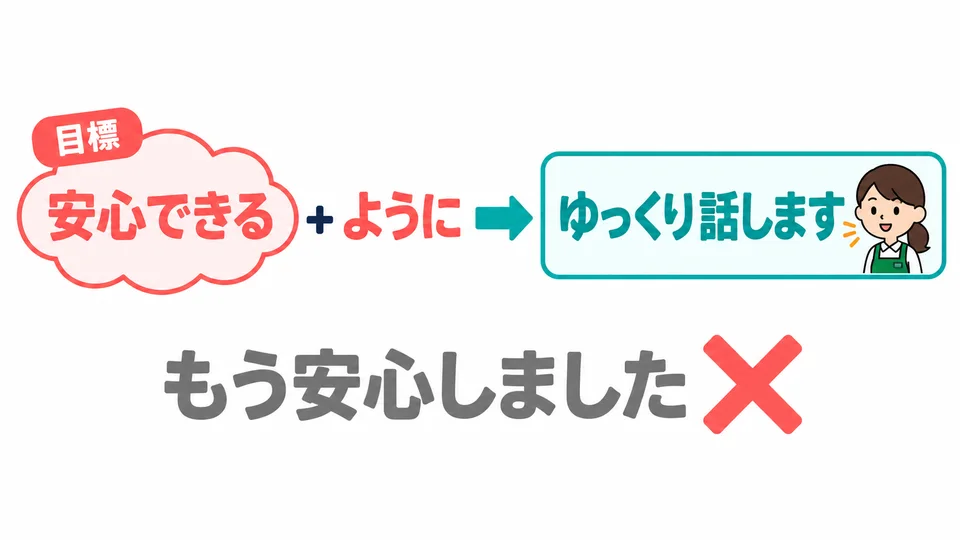
  1. Why speak slowly? To help the customer feel at ease. The cloud-shaped frame shows the desired state.
    Why speak slowly? To help the customer feel at ease. The cloud-shaped frame shows the desired state.

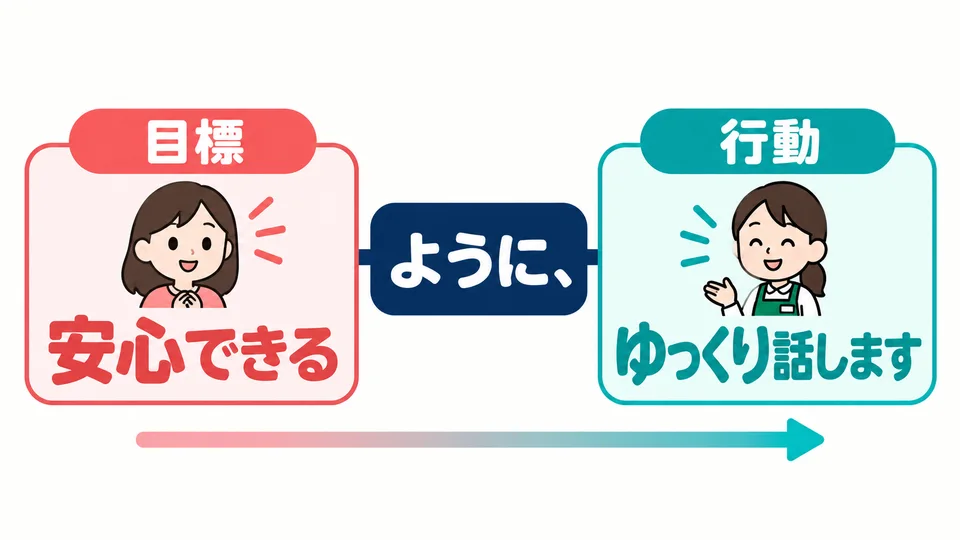
  2. Before 「ように」 comes the goal; after it comes the action. First say what you hope for, then what you do to make it happen.
    Before 「ように」 comes the goal; after it comes the action. First say what you hope for, then what you do to make it happen.

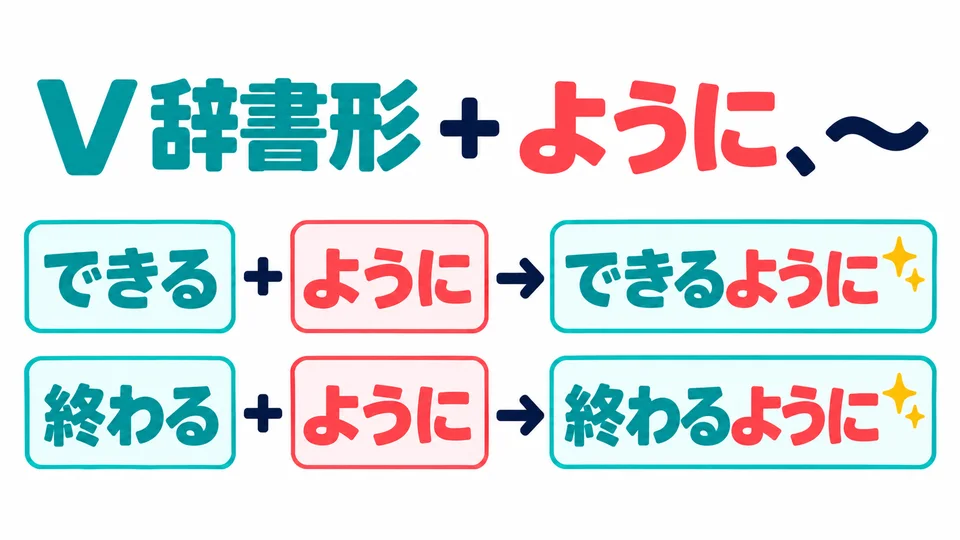
  3. To express a state you hope to achieve, use a verb in dictionary form + 「ように」, followed by the action taken toward that goal.
    To express a state you hope to achieve, use a verb in dictionary form + 「ように」, followed by the action taken toward that goal.

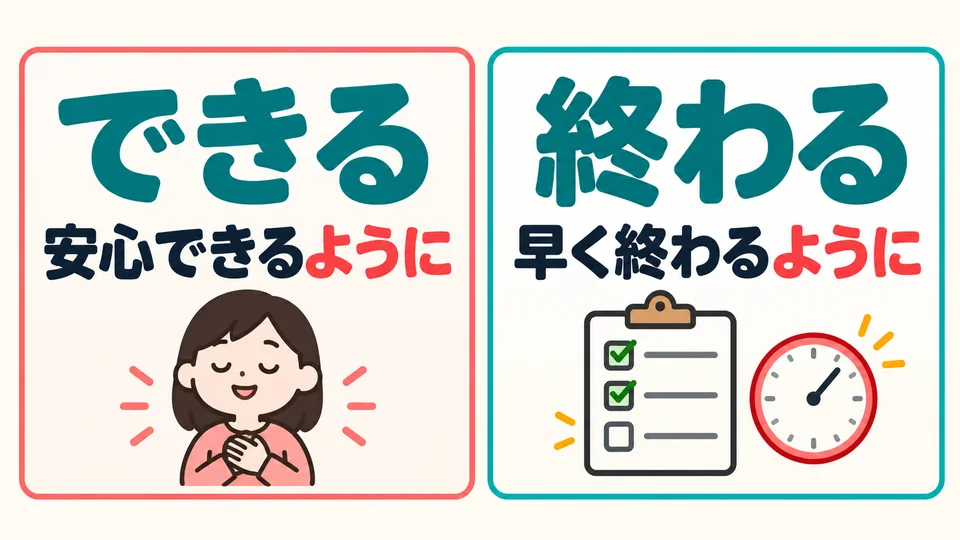
  4. Verbs expressing ability or a state, such as 「できる」 and 「終わる」, often come before 「ように」.
    Verbs expressing ability or a state, such as 「できる」 and 「終わる」, often come before 「ように」.

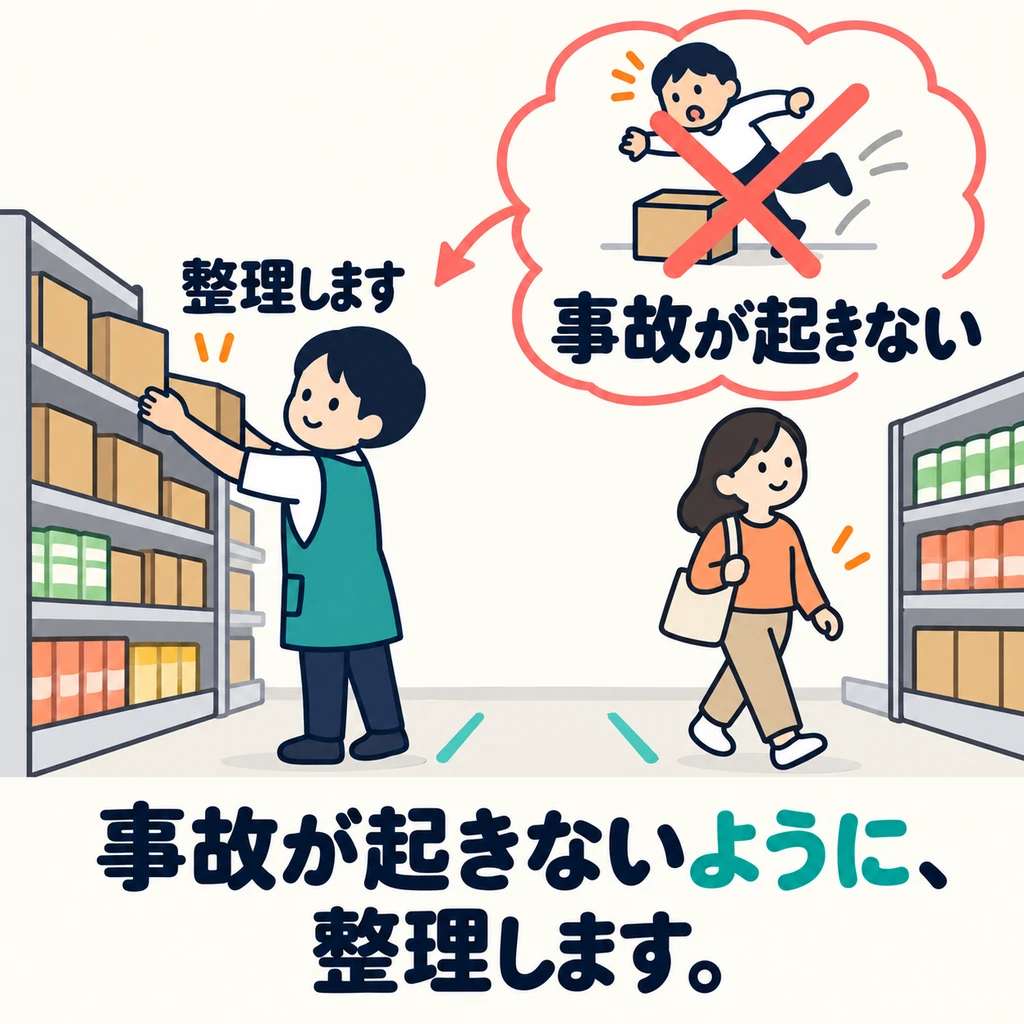
  5. Why tidy up? To prevent accidents. The crossed-out scene shows something you do not want to happen.
    Why tidy up? To prevent accidents. The crossed-out scene shows something you do not want to happen.

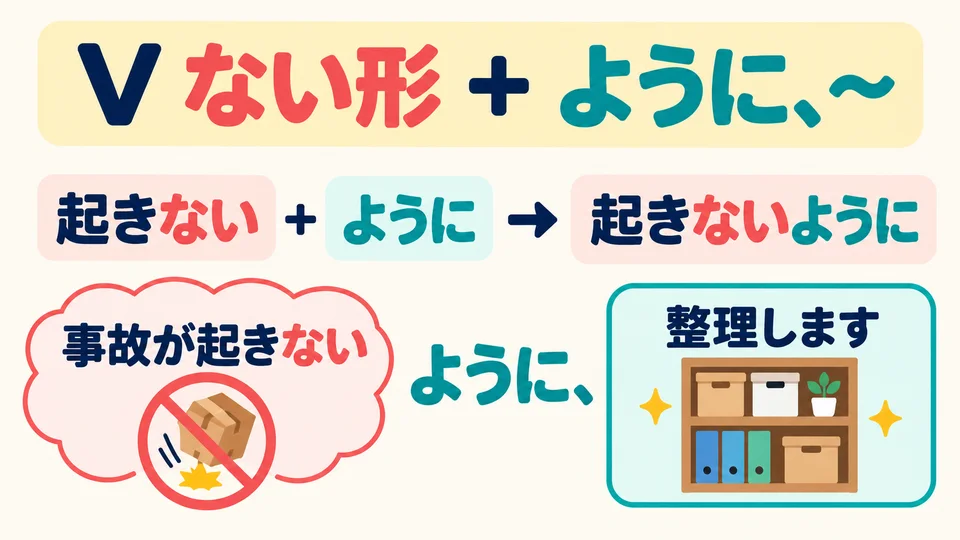
  6. To express something you hope will not happen, use a verb in ない form + 「ように」, then state the action taken to prevent it.
    To express something you hope will not happen, use a verb in ない form + 「ように」, then state the action taken to prevent it.

  7. This expresses the purpose of the action. It does not mean the goal has already been reached or an accident has already happened.
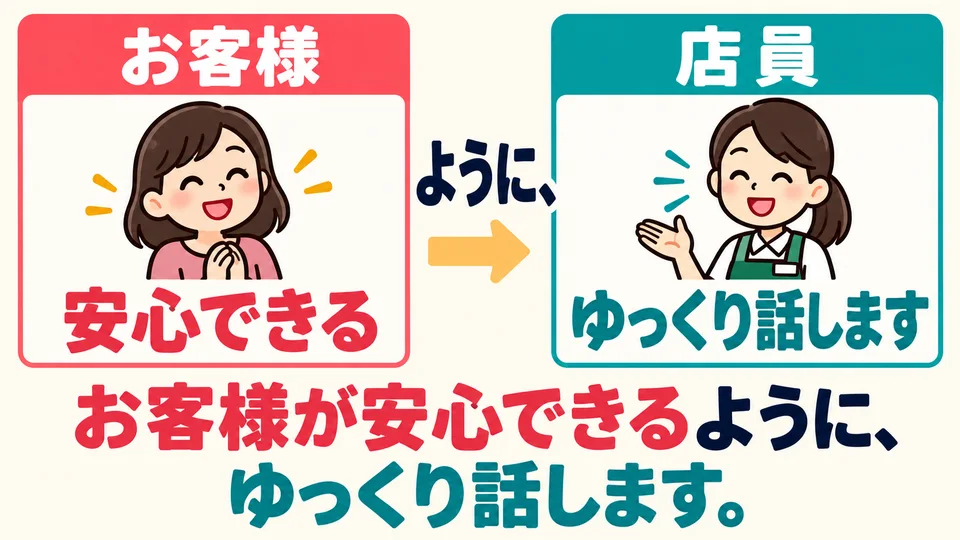
    This expresses the purpose of the action. It does not mean the goal has already been reached or an accident has already happened.

  8. In the example, the customer is the one who should feel at ease, while the shop worker speaks slowly. The two clauses can have different subjects.

    In the example, the customer is the one who should feel at ease, while the shop worker speaks slowly. The two clauses can have different subjects.

Example sentences

  • お客様おきゃくさまokyakusamaがga安心あんしんanshinできるdekiruように、ようにyouniゆっくりyukkuri話します。はなしますhanashimasu

    So that customers feel at ease, I'll speak slowly.

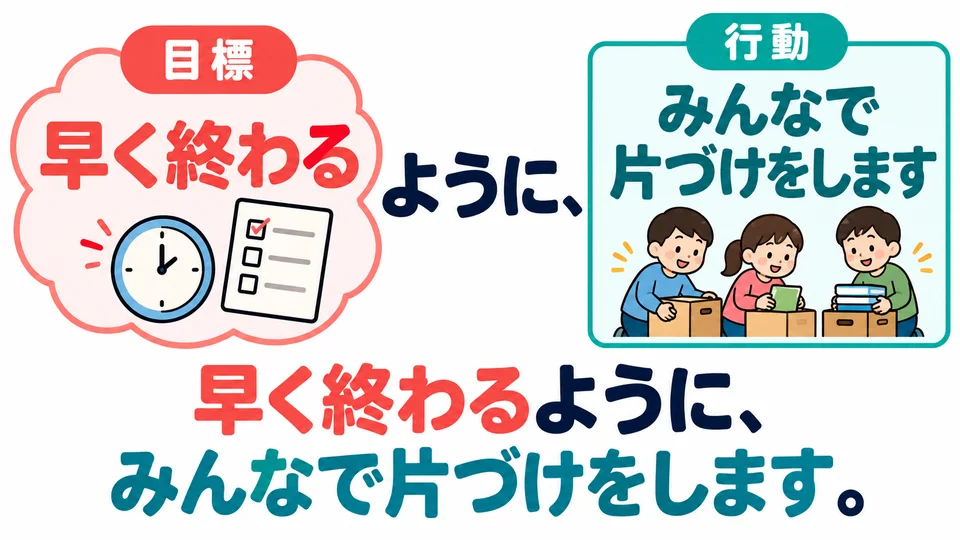
  • 早くはやくhayaku終わるおわるowaru

In a conversation

  • A
    新しくあたらしくアルバイトあるばいとを始めるはじめるんですが、が何なんか注意ちゅうい点てんはわありますか。か

    A: I'm starting a new part-time job. Are there any points I should be careful about?

  • B

Check yourself

  1. Level 1 · Recognise

    Which sentence is correct?

  2. Level 1 · Recognise

    Listen and choose the meaning

  3. Level 2 · Build

    Put the words in order

    I always organize the workspace so that accidents don't occur.

  4. Level 3 · Use

    What goes in the blank?

    お客様に迷惑をかけ (「ように」を含めて)気をつけています。

    I'm being careful not to cause trouble for the customers.

More grammar in this theme

  • 〜ように、〜action toward a desired result

More JLPT N4 grammar

Keep practising

Test your Japanese vocabulary12 adaptive questions, freeCheck your pronunciationRead aloud and get a scorePractise verb forms10-question conjugation quizSee the whole courseGrammar, vocabulary and quizzes by theme
  • Everyone cleaning up together is the action; 「早く終わる」 is the result they hope to achieve.

    Everyone cleaning up together is the action; 「早く終わる」 is the result they hope to achieve.

  • ように、ようにyouni
    みんなminna
    でde
    片づけかたづけkatazuke
    をo
    します。しますshimasu

    So that we finish quickly, everyone will help clean up.

    はい、はいお客様おきゃくさまに迷惑めいわくをかけないように、ように丁寧なていねいな言葉遣いことばづかいを心がけこころがけてください。ください

    B: Yes, so as not to inconvenience customers, please be mindful of using polite language.

    • A
      分かりました。わかりました他ほかにもありますか。か

      A: Understood. Is there anything else?

    • B
      事故じこが起きないおきないように、ように作業さぎょう場ばはわ常つねに整理せいりしてください。ください

      B: So that accidents don't happen, please keep the workplace tidy at all times.

    Beginner 3
    Social Life
    More quizzesOpen this lesson’s quizzes in the course
    〜ことになっていますestablished rule or convention
    〜ようにしてくださいgentle request to make sure
    お〜ください/ご〜くださいformal polite instruction
    〜そうです(様態)looks about to happen
    〜ておきますleave in a state
    〜てしまいましたcompletely finished
    〜ことになっていますsettled plan or assignment
    Previous〜ことになっています
    Next〜ようにしてください
    See all 138
    Nをいただきますhumbly receive something
    Nをくださいますsomeone respectfully gives me something
    〜ていただきますhumbly receive someone’s help
    〜てくださいましたrespectful help received
    受身形passive voice, receiver in focus
    〜みたいですseems, based on clues
    〜ところですaction stage right now
    〜てきますgradual approach or appearance