JPEDLAB iconJPEDLAB
Save history

Create an account and play

Explore first, then save your progress whenever you are ready. No email address is required.

Start free
Read as articleCards
See the whole course›Intermediate 3›Richness and Beauty of Japanese Expression

Japanese grammar · ≈ JLPT N3 · Intermediate 3

〜ほど・〜くらい・〜ぐらい~hodo / ~kurai / ~gurai

degree shown by an example

Use 「〜ほど/〜くらい」 to show how strong a feeling is, with a concrete reaction or an exaggerated image.

Start the interactive lessonIllustrated cards, audio and speaking practice

How it works

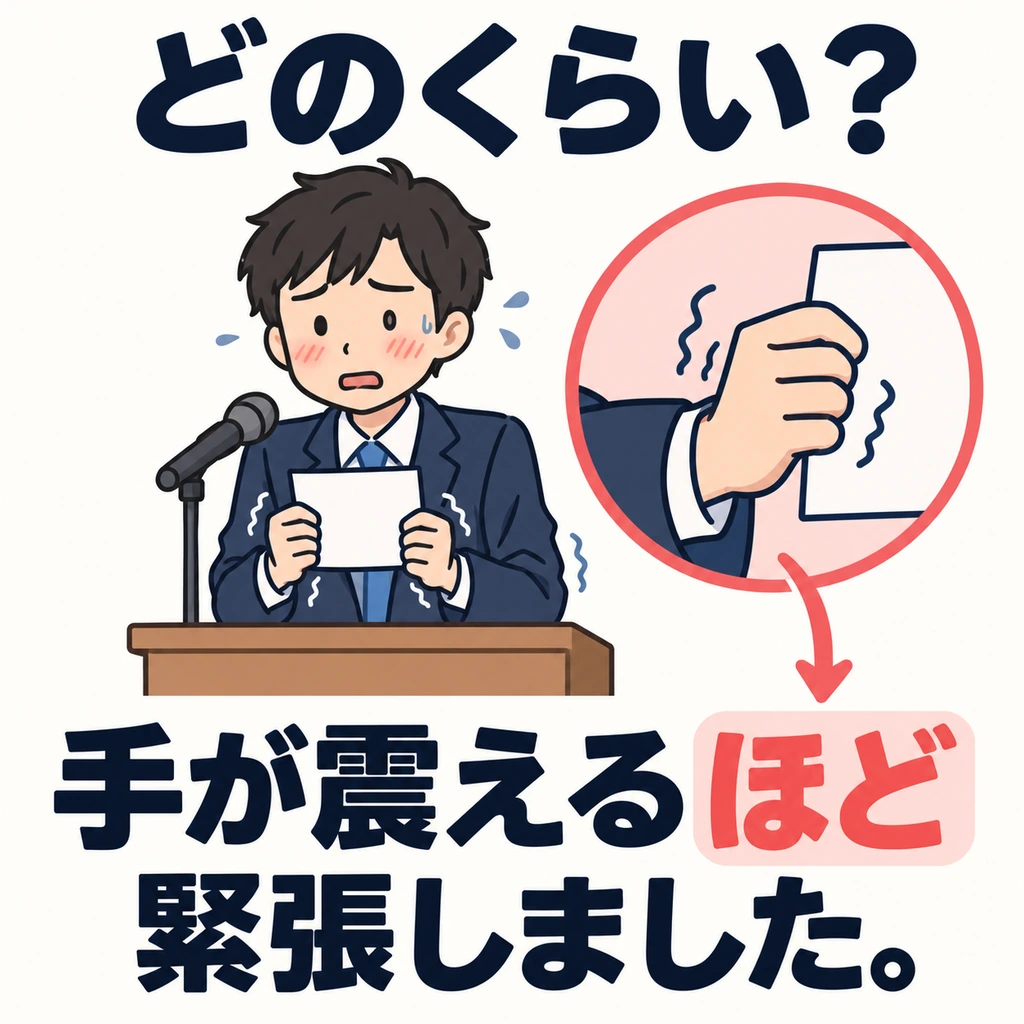
  1. How nervous? The concrete reaction “hands shaking” shows the degree of nervousness.
    How nervous? The concrete reaction “hands shaking” shows the degree of nervousness.

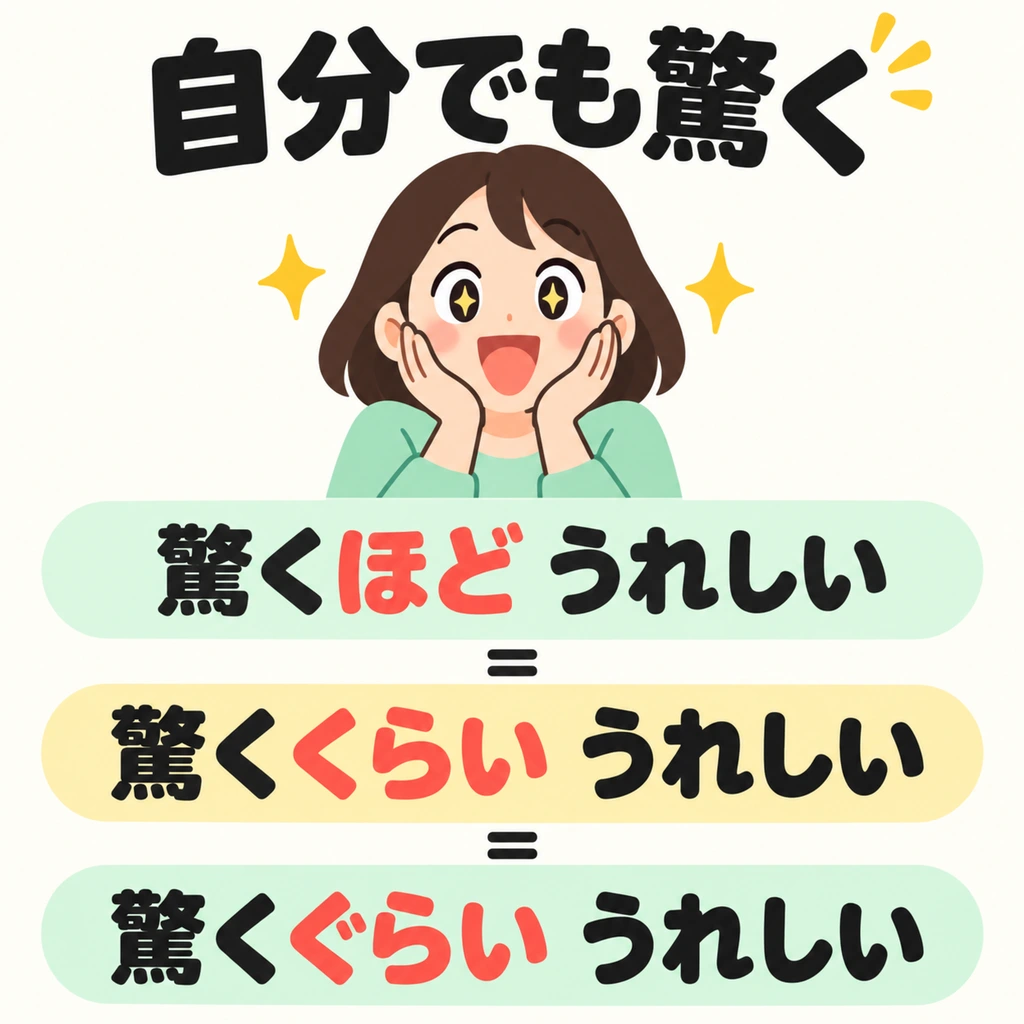
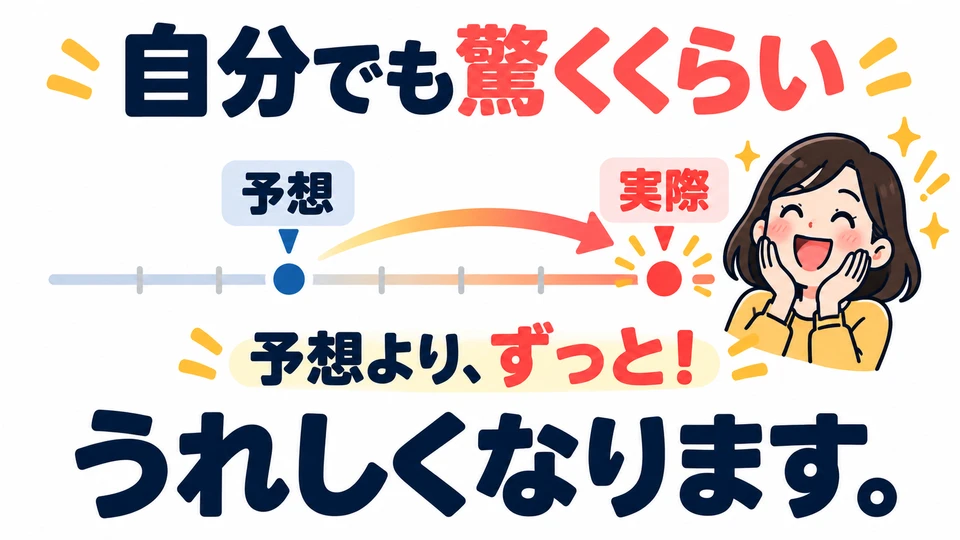
  2. “Even surprising myself” shows how happy I am. Here, the three expressions have similar meanings.
    “Even surprising myself” shows how happy I am. Here, the three expressions have similar meanings.

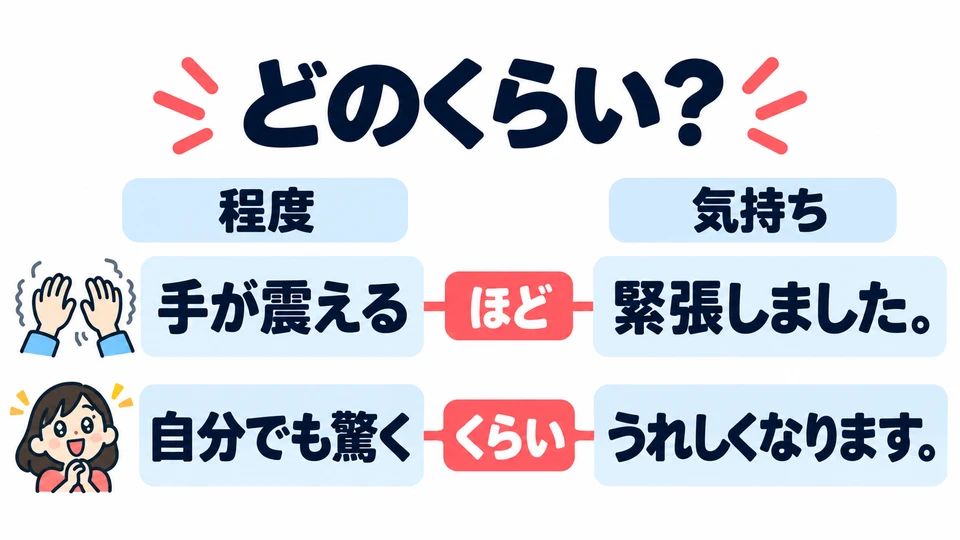
  3. The first part gives a measure of degree; the second states the feeling. Together, they answer “How nervous or happy?”
    The first part gives a measure of degree; the second states the feeling. Together, they answer “How nervous or happy?”

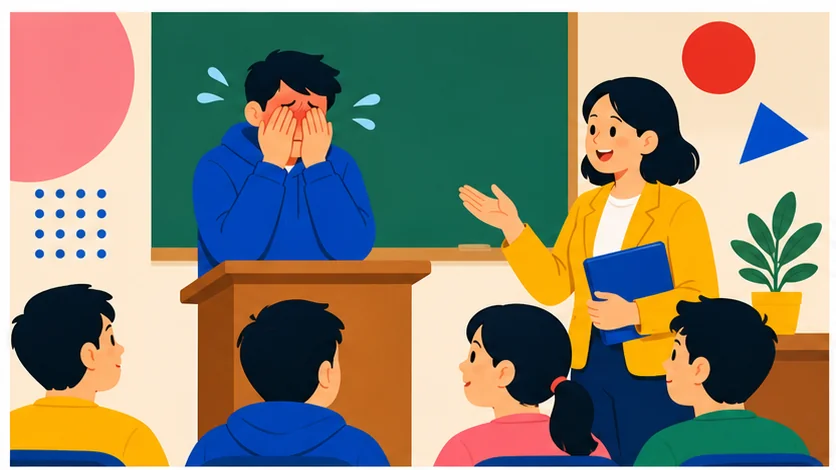
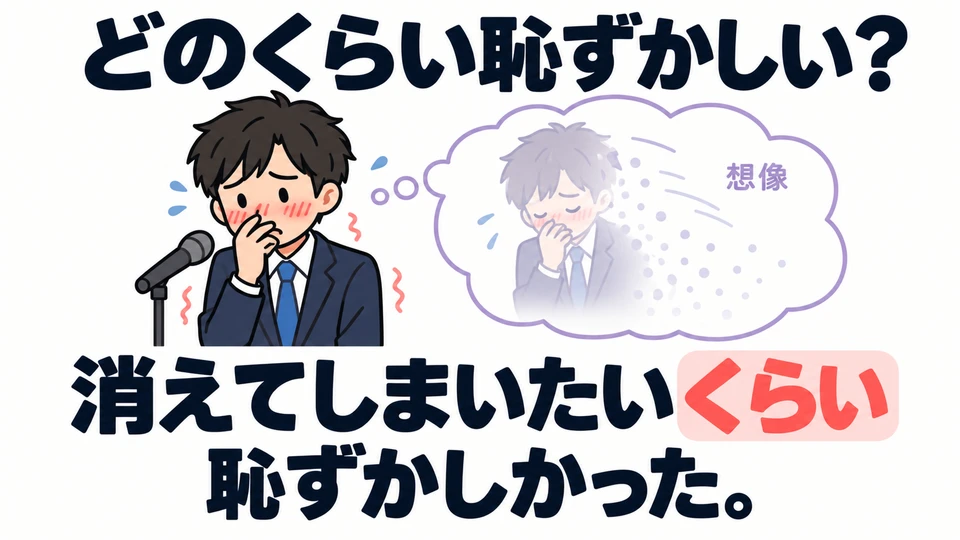
  4. The concrete example can also be an exaggerated image: “wanting to disappear” describes the degree of embarrassment.
    The concrete example can also be an exaggerated image: “wanting to disappear” describes the degree of embarrassment.

  5. The second sentence emphasizes being happier than you yourself expected; it does not compare who is happier.

    The second sentence emphasizes being happier than you yourself expected; it does not compare who is happier.

Example sentences

  • 初めてはじめてhajimete日本にほんnihon語ごgoでde発表はっぴょうhappyouしたとき、shitatoki、手てteがga震えるふるえるfurueruほどhodo緊張きんちょうkinchou

In a conversation

Check yourself

  1. Level 1 · Recognise

    Which sentence is correct?

  2. Level 1 · Recognise

    Listen and choose the meaning

  3. Level 2 · Build

    Put the words in order

    When I gave a presentation in Japanese for the first time, I was so nervous my hands were shaking.

  4. Level 3 · Use

    What goes in the blank?

    初めて日本語で発表したとき、手が震える____緊張しました。

    When I gave a speech in Japanese for the first time, I was so nervous my hands were shaking.

More grammar in this theme

  • 〜ほど・〜くらい・〜ぐらいdegree shown by an example

Keep practising

Test your Japanese vocabulary12 adaptive questions, freeCheck your pronunciationRead aloud and get a scorePractise verb forms10-question conjugation quizSee the whole courseGrammar, vocabulary and quizzes by theme
しました。shimashita。

When I gave a presentation in Japanese for the first time, I was so nervous that my hands were shaking.

  • A
    スピーチすぴーちのとき、どうだった?だった

    A: How did it go during the speech?

  • B
    もう、消えきえてしまいたいくらい恥ずかしかったはずかしかったよ。最初さいしょの一いち文ぶんを言いいい間違えちゃっまちがえちゃって。

    B: I was so embarrassed I wanted to disappear. I misspoke the very first sentence.

  • 日本にほんnihon語ごgoでde気持ちきもちkimochiがga伝わったときつたわったときtsutawattatokiは、わ、wa、自分じぶんjibunでdeもmo驚くおどろくodorokuくらいkuraiうれしくureshikuなります。narimasu。

    When I'm able to convey my feelings in Japanese, I get so happy that it even surprises myself.

  • A
    でも最後さいごまで続けられたつづけられたんでしょ?でしょそれだけで十分じゅうぶんすごいよ。

    A: But you kept going until the end, didn't you? That alone is amazing enough.

  • 〜がたいsubjectively hard to do
    〜のようにlike; in the manner of
    〜とともにalong with; as … changes
    〜をもとに(して)・〜をもとにしたbased on; using as a basis
    〜でしょう?seeking agreement
    〜っけrecalling and checking
    〜というわけだthat explains why
    〜っこないabsolutely impossible
    〜もん・〜んだもんemotional reason or plea
    〜ところだったsomething almost happened
    〜てたまらないoverwhelmingly intense feeling
    〜というわけではないthat does not mean
    〜くらい・〜ぐらいdegree shown by a situation
    Previous〜もん・〜んだもん
    Next〜ところだった