JPEdLab iconJPEdLab
Save history

Create an account and play

Explore first, then save your progress whenever you are ready. No email address is required.

Start free
  1. Japanese grammar
  2. JLPT N4 grammar
  3. 〜のように

〜のように~ no you ni

No you ni (〜のように) means “like; in the manner of”.

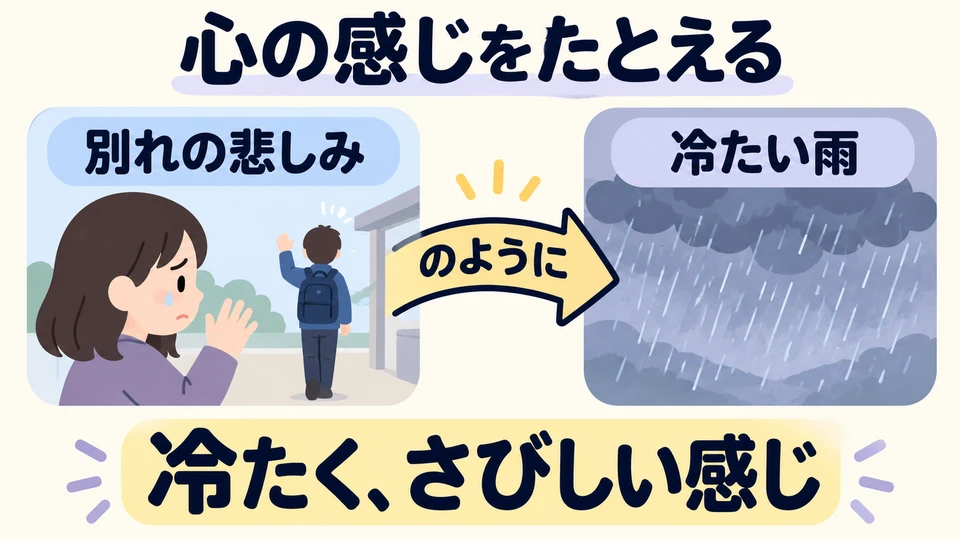
作者さくしゃsakushaは、わ、wa、別れわかれwakareのno悲しみかなしみkanashimiをo冷たいつめたいtsumetai雨あめameのnoように描いようにえがいyouniegaiてteいます。imasu。

The author describes the sadness of parting like cold rain.

Use 「〜のように」 to compare things that are similar in a particular way, without saying they are identical.

In the course›

How it works

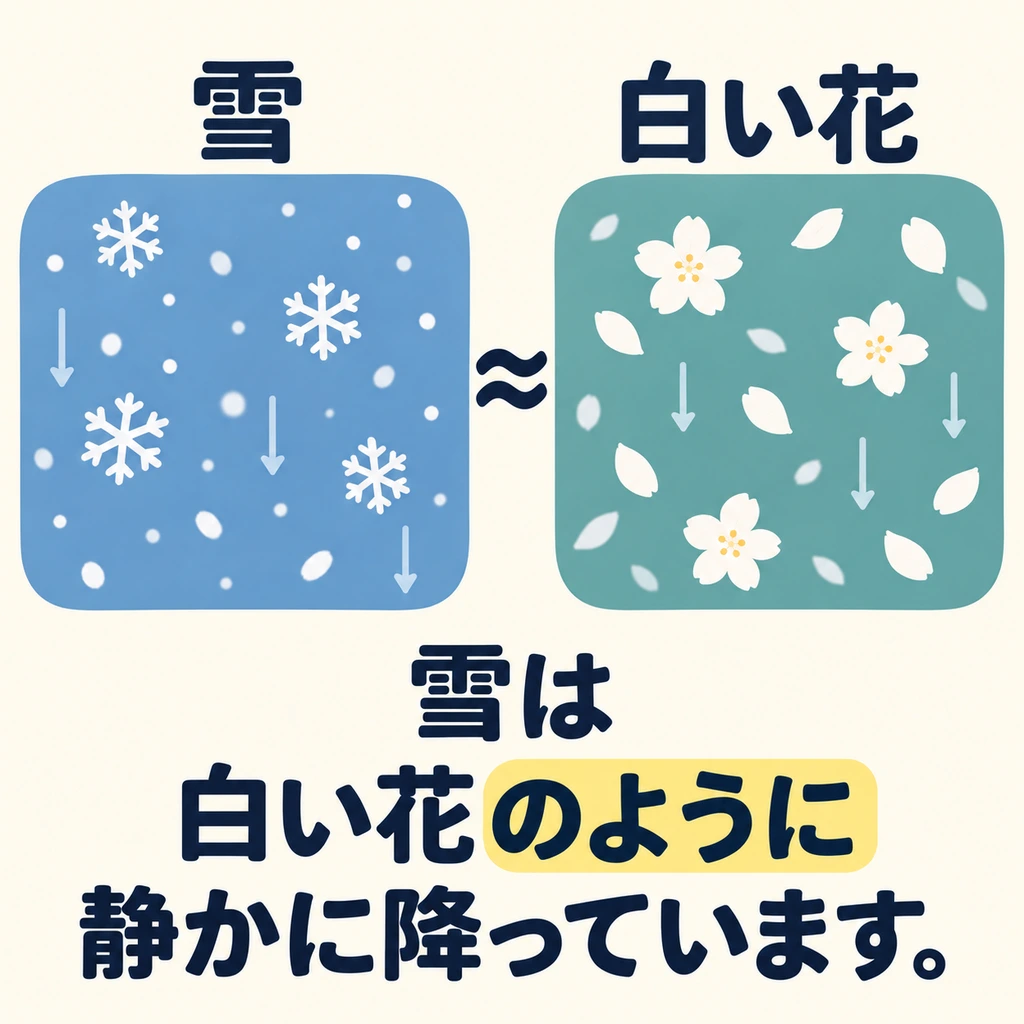
  1. Look at the snow and the white flowers. What do their color and the way they fall have in common? First, find the similarities.
    Look at the snow and the white flowers. What do their color and the way they fall have in common? First, find the similarities.

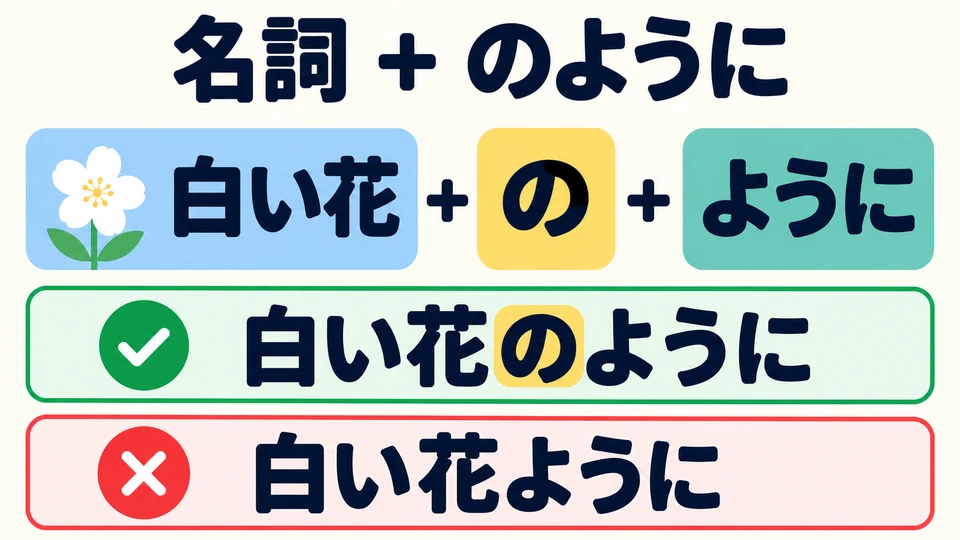
  2. Put the noun used for the comparison before 「のように」. You cannot leave out 「の」 after the noun.
    Put the noun used for the comparison before 「のように」. You cannot leave out 「の」 after the noun.

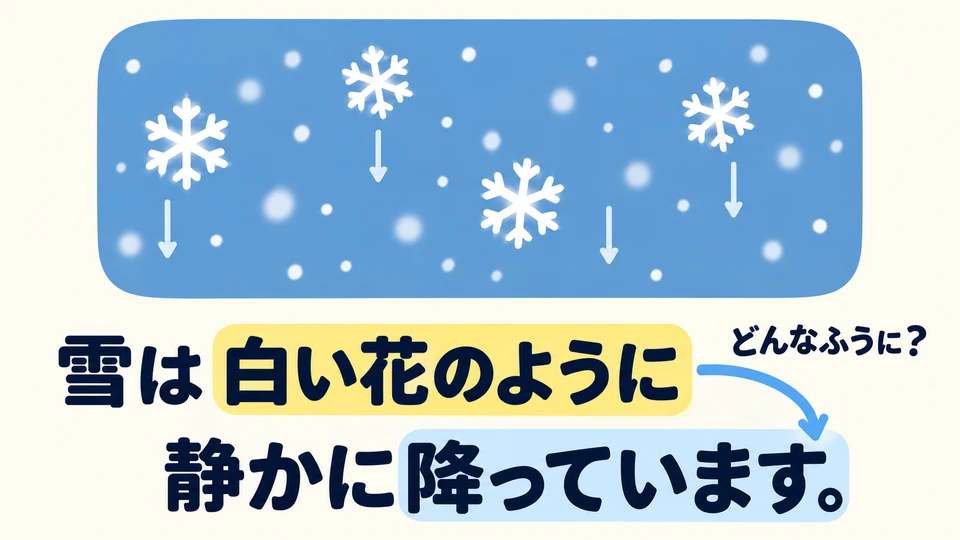
  3. 「白い花のように」 describes the falling action that follows, giving a more vivid picture of how the snow falls.
    「白い花のように」 describes the falling action that follows, giving a more vivid picture of how the snow falls.

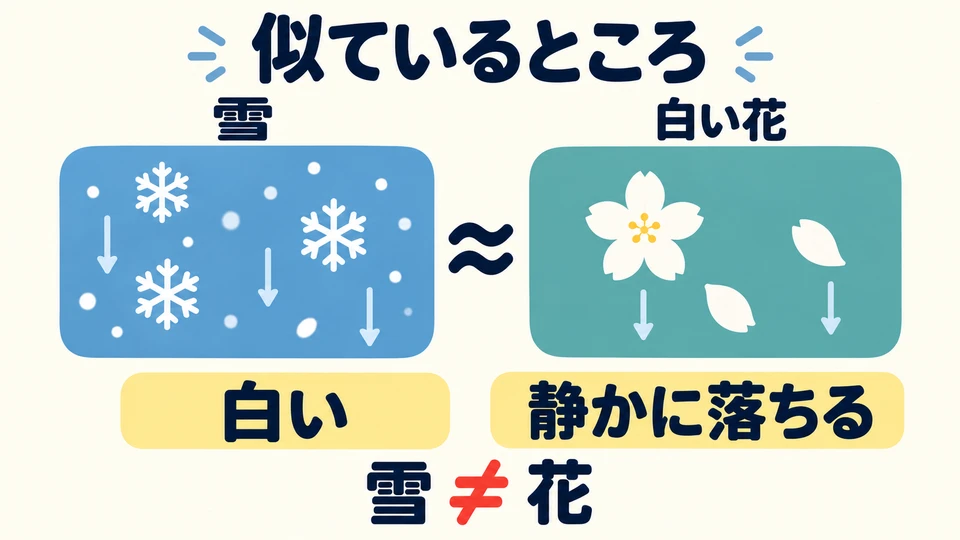
  4. 「ように」 shows a similarity in some way, not that the two things are identical. Snow is like white flowers, but it is still snow.
    「ように」 shows a similarity in some way, not that the two things are identical. Snow is like white flowers, but it is still snow.

  5. The example compares the sadness of parting to cold rain. The bleak feeling of the rain conveys an emotion; it does not mean it is actually raining.

    The example compares the sadness of parting to cold rain. The bleak feeling of the rain conveys an emotion; it does not mean it is actually raining.

Example sentences

  • 作者さくしゃsakushaは、わ、wa、別れわかれwakareのno悲しみかなしみkanashimiをo冷たいつめたいtsumetai雨あめameのnoように描いようにえがいyouniegaiてte

In a conversation

  • A
    この詩しの比喩、ひゆ、すごく好きだすきだな。故郷こきょうを遠いとおい星ほしのように表現ようにひょうげんしているよね。

Check yourself

  1. Level 1 · Recognise

    Which sentence is correct?

  2. Level 1 · Recognise

    Listen and choose the meaning

  3. Level 2 · Build

    Put the words in order

    The snow is falling quietly like white flowers.

  4. Level 3 · Use

    What goes in the blank?

    作者は、別れの悲しみを冷たい雨の____描いています。

    The author depicts the sorrow of parting like cold rain.

More grammar in this theme

  • 〜のようにlike; in the manner of

More JLPT N4 grammar

Keep practising

Test your Japanese vocabulary12 adaptive questions, freeCheck your pronunciationRead aloud and get a scorePractise verb forms10-question conjugation quizSee the whole courseGrammar, vocabulary and quizzes by theme
います。
imasu。

The author describes the sadness of parting like cold rain.

  • 雪ゆきyukiはわwa白いしろいshiroi花はなhanaのnoように静かに降っようにしずかにふっyounishizukanifuてteいます。imasu。

    The snow is falling silently like white flowers.

  • A: I really like the metaphors in this poem. It expresses one's hometown like a distant star, doesn't it?

  • B
    そうそう、詩人しじんの印象いんしょうの表し方あらわしかたが独特で、どくとくで、読むよむたびに違うちがう場面ばめんが浮かぶうかぶよ。

    B: Yes, the poet's way of expressing impressions is unique, and a different scene comes to mind every time I read it.

  • A
    作者さくしゃの背景はいけいを知るしると、なぜ星ほしのように描いたようにえがいたのか解釈かいしゃくできる気きがする。

    A: Knowing the author's background, I feel I can interpret why they depicted it like a star.

  • Intermediate 3
    Richness and Beauty of Japanese Expression
    〜がたいsubjectively hard to do
    〜とともにalong with; as … changes
    〜をもとに(して)・〜をもとにしたbased on; using as a basis
    〜でしょう?seeking agreement
    〜っけrecalling and checking
    〜というわけだthat explains why
    〜っこないabsolutely impossible
    〜もん・〜んだもんemotional reason or plea
    〜ほど・〜くらい・〜ぐらいdegree shown by an example
    〜ところだったsomething almost happened
    〜てたまらないoverwhelmingly intense feeling
    〜というわけではないthat does not mean
    〜くらい・〜ぐらいdegree shown by a situation
    Previous〜がたい
    Next〜とともに
    See all 138
    〜に囲まれている・〜に囲まれたbe surrounded by
    〜のような・〜のようにexamples such as
    〜ことになったit has been decided
    人を〜にさせるtrigger someone’s feelings
    〜ば・〜ならばif; on the condition that
    〜たら・〜ためにif; in order to
    ご〜いたします・お〜いたしますhumbly provide a service
    〜させられるbe prompted to feel or think
    More quizzesOpen this lesson’s quizzes in the course