JPEDLAB iconJPEDLAB
Save history

Create an account and play

Explore first, then save your progress whenever you are ready. No email address is required.

Start free
Read as articleCards
See the whole course›Intermediate 3›Richness and Beauty of Japanese Expression

Japanese grammar · ≈ JLPT N2 · Intermediate 3

〜というわけではない~to iu wake de wa nai

that does not mean

Use 「〜というわけではない」 to correct an inference, rejecting “always” or “only” while other uses may remain true.

Start the interactive lessonIllustrated cards, audio and speaking practice

How it works

  1. Use this to correct a statement or inference you hear: it means “that is not the case” or “it does not mean that.”
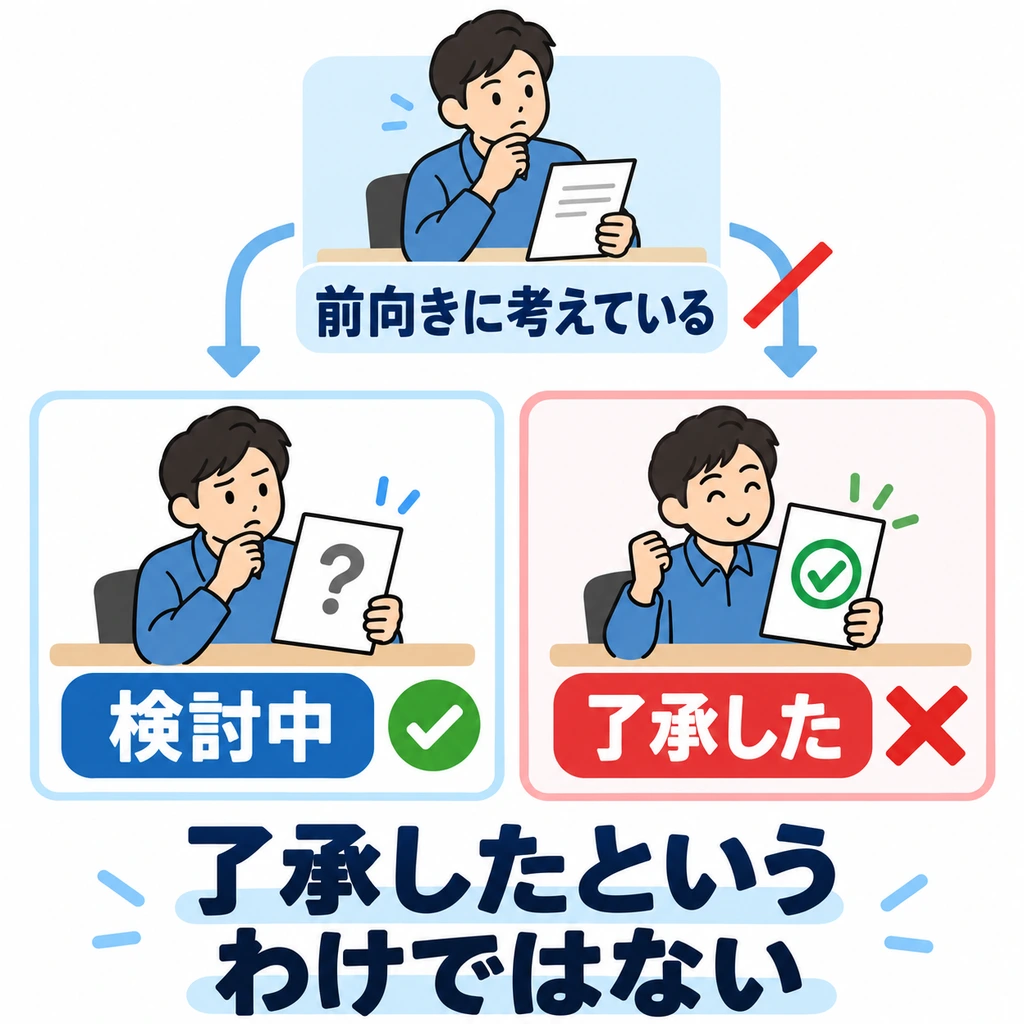
    Use this to correct a statement or inference you hear: it means “that is not the case” or “it does not mean that.”

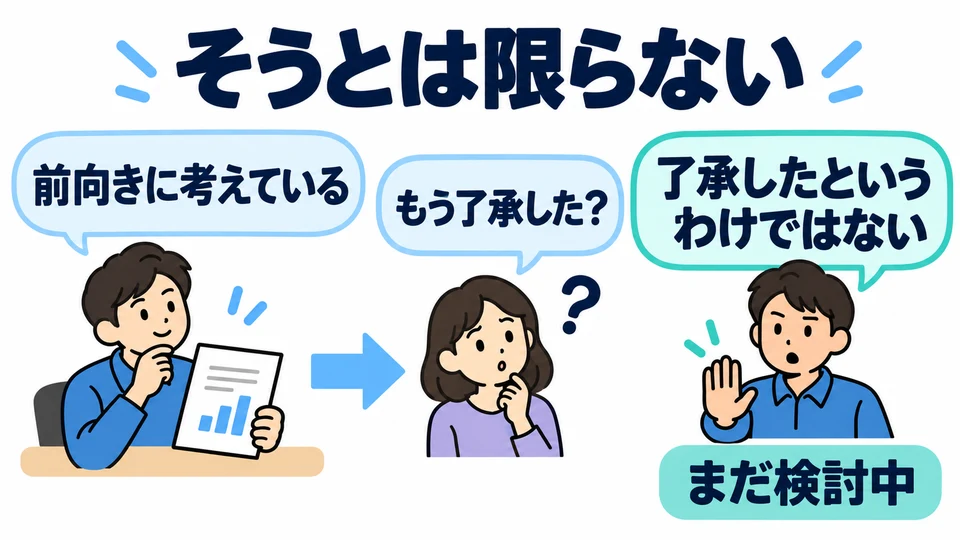
  2. Does considering something positively mean you have already agreed? Use 「というわけではない」 to correct the other person’s inference.
    Does considering something positively mean you have already agreed? Use 「というわけではない」 to correct the other person’s inference.

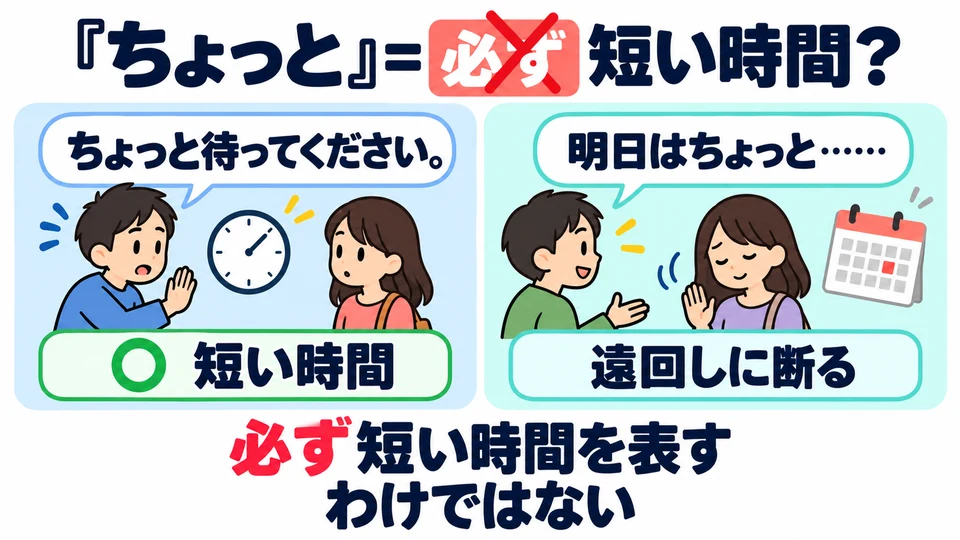
  3. The first example rejects “it always means a short time.” It does not rule out 「ちょっと」 meaning a short time.
    The first example rejects “it always means a short time.” It does not rule out 「ちょっと」 meaning a short time.

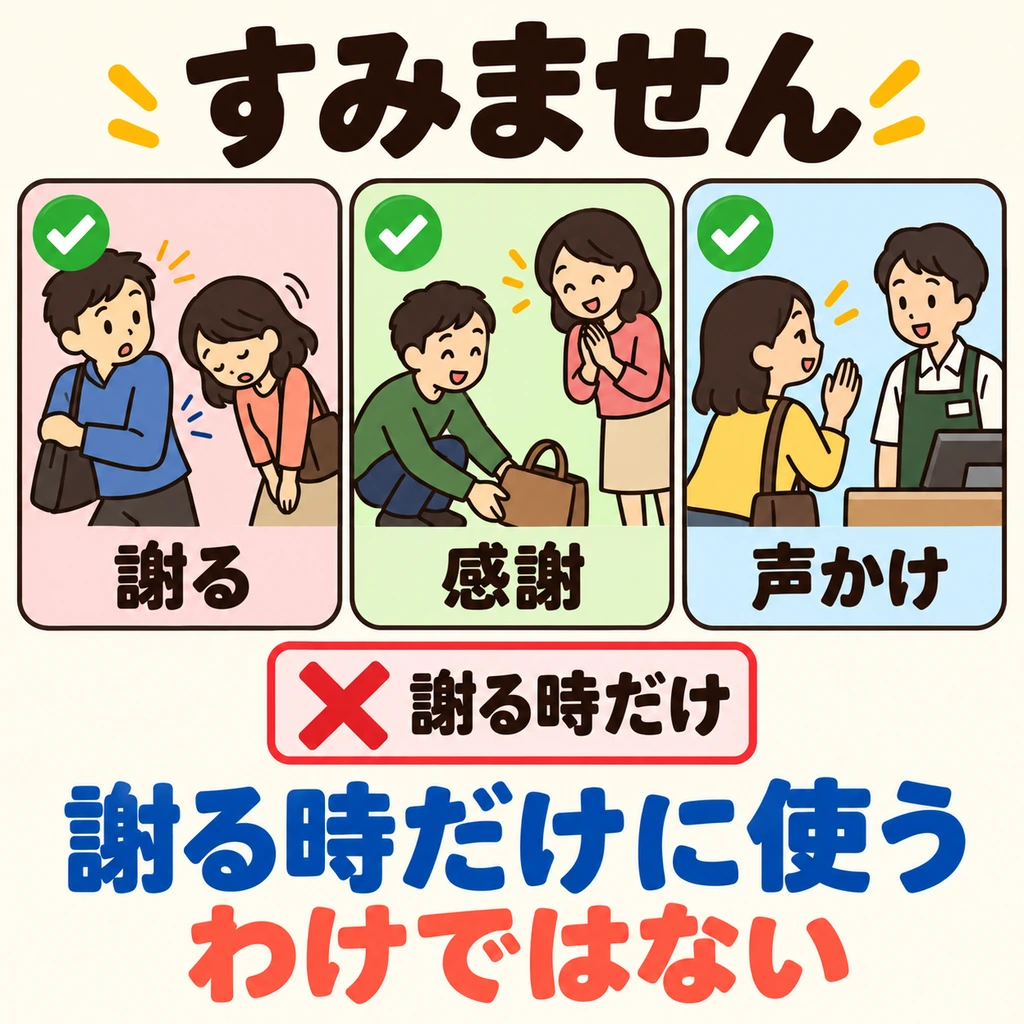
  4. The second example rejects “used only to apologize.” The apology use remains valid; it can also express thanks or get someone’s attention.
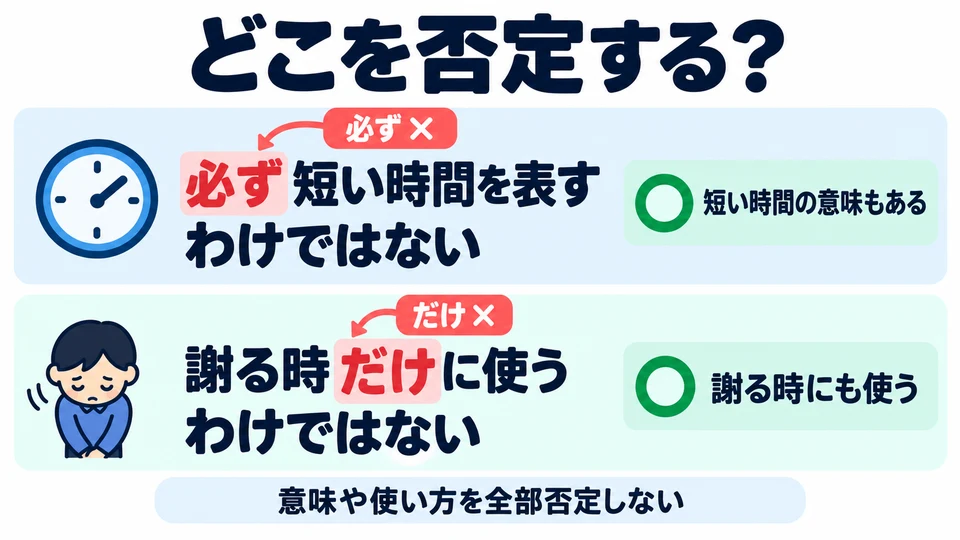
    The second example rejects “used only to apologize.” The apology use remains valid; it can also express thanks or get someone’s attention.

  5. In both examples, check the scope of the negation: 「必ず」 and 「だけ」 are negated, while the original uses can still be valid.

    In both examples, check the scope of the negation: 「必ず」 and 「だけ」 are negated, while the original uses can still be valid.

Example sentences

  • 日本人にほんじんnihonjinが「がgaちょっと」ちょっとchottoとto言ったら、いったら、ittara、必ずかならずkanarazu短いみじかいmijikai時間じかんjikanをo表すあらわすarawasu

In a conversation

Check yourself

  1. Level 1 · Recognise

    Which sentence is correct?

  2. Level 1 · Recognise

    Listen and choose the meaning

  3. Level 2 · Build

    Put the words in order

    Just because a clerk approaches you doesn't mean you have to buy something.

  4. Level 3 · Use

    What goes in the blank?

    日本人が「ちょっと」と言ったら、必ず短い時間を表す____。

    When Japanese people say "chotto," it does not always mean a short amount of time.

More grammar in this theme

  • 〜というわけではないthat does not mean

Keep practising

Test your Japanese vocabulary12 adaptive questions, freeCheck your pronunciationRead aloud and get a scorePractise verb forms10-question conjugation quizSee the whole courseGrammar, vocabulary and quizzes by theme
わけ
wake
でde
はわwa
ありません。arimasen。

When a Japanese person says 'chotto', it does not necessarily mean a short period of time.

  • A
    田中さん、たなかさん、あの件けんはわもう了承りょうしょうしたんですか?か

    A: Mr. Tanaka, has he already agreed to that matter?

  • B
    了承りょうしょうしたというわけではわないんですが、前向きに考えまえむきにかんがえているとのことでした。

    B: It's not that he has approved it, but I heard he is considering it positively.

  • 「すみません」すみませんsumimasenはわwa謝るあやまるayamaru時ときtokiだけdakeにni使うつかうtsukauわけwakeでdeはわwaなく、naku、感謝かんしゃkanshaやya声かけこえかけkoekakeにniもmo使います。つかいます。tsukaimasu。

    'Sumimasen' is not only used for apologizing, but also for expressing gratitude and calling out to someone.

  • A
    そうですか、ではわもう少しすこし待っまってみましょう。

    A: I see, then let's wait a little longer.

  • 〜がたいsubjectively hard to do
    〜のようにlike; in the manner of
    〜とともにalong with; as … changes
    〜をもとに(して)・〜をもとにしたbased on; using as a basis
    〜でしょう?seeking agreement
    〜っけrecalling and checking
    〜というわけだthat explains why
    〜っこないabsolutely impossible
    〜もん・〜んだもんemotional reason or plea
    〜ほど・〜くらい・〜ぐらいdegree shown by an example
    〜ところだったsomething almost happened
    〜てたまらないoverwhelmingly intense feeling
    〜くらい・〜ぐらいdegree shown by a situation
    Previous〜てたまらない
    Next〜くらい・〜ぐらい