JPEdLab iconJPEdLab
Save history

Create an account and play

Explore first, then save your progress whenever you are ready. No email address is required.

Start free
  1. Japanese grammar
  2. JLPT N4 grammar
  3. 〜ことになった

〜ことになった~koto ni natta

Koto ni natta (〜ことになった) means “it has been decided”.

来週、らいしゅう、raishuu、地域ちいきchiiki交流こうりゅうkouryuu会かいkaiにni参加さんかsankaするsuruことkotoにniなりました。narimashita。

It has been decided that I will participate in the community exchange meeting next week.

Use 〜ことになった to report a decision or arrangement that is already settled, without stressing who made it.

In the course›

How it works

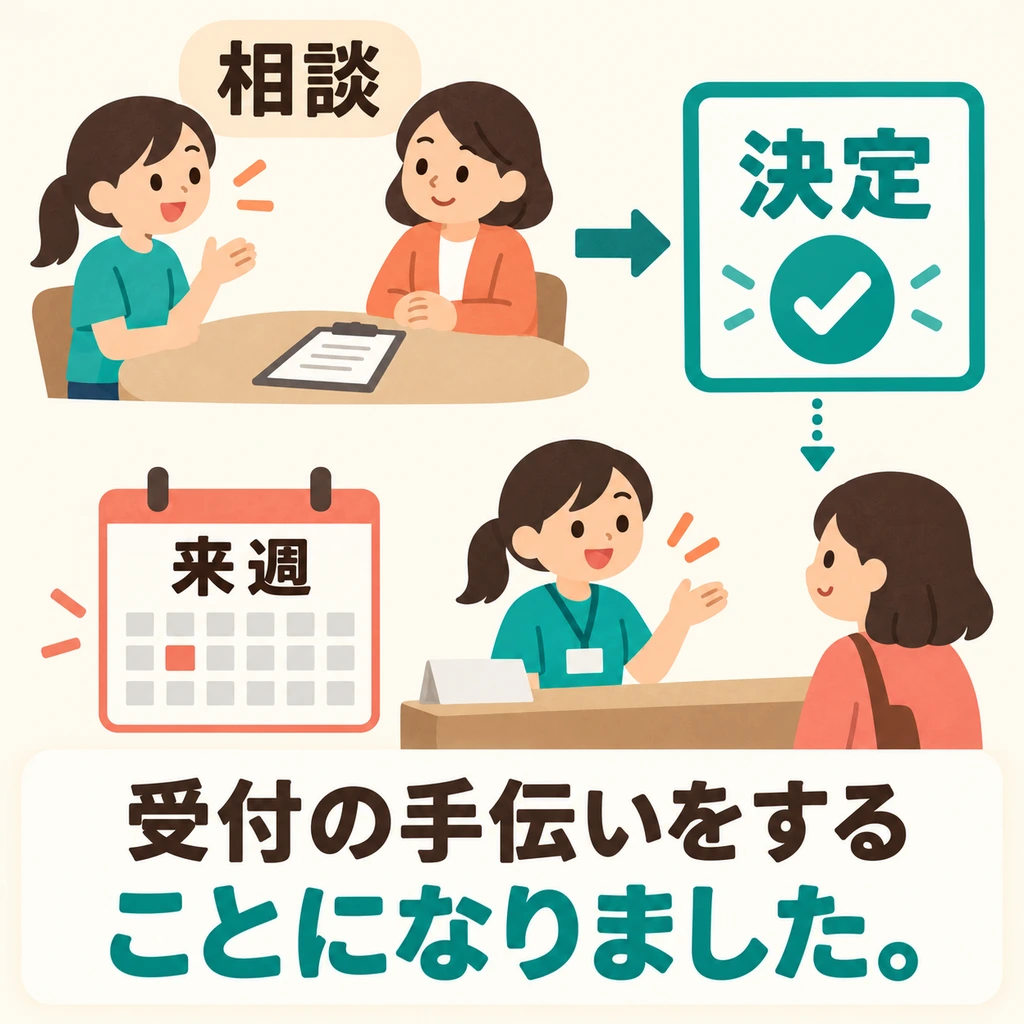
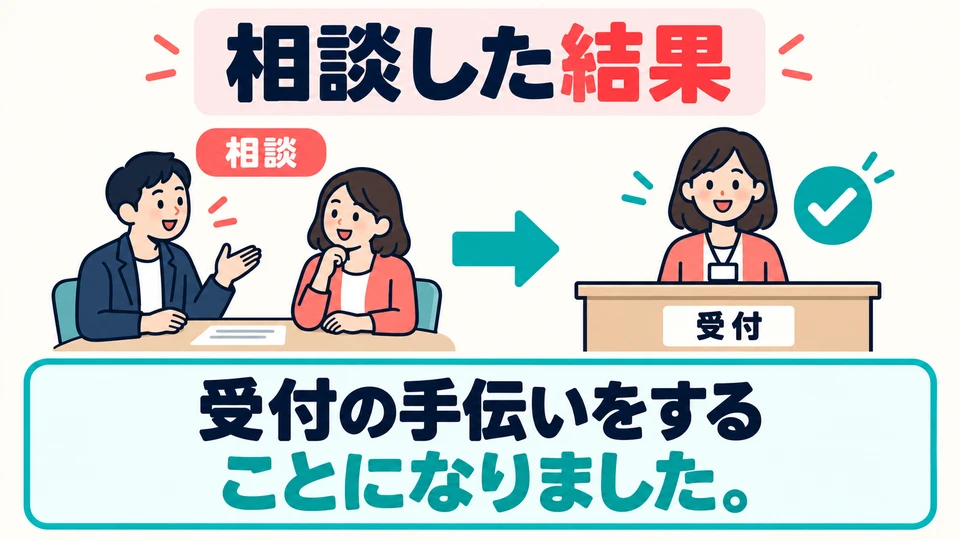
  1. Look at the picture: after talking with the organizer, the reception role is settled. Use this pattern to report a confirmed arrangement.
    Look at the picture: after talking with the organizer, the reception role is settled. Use this pattern to report a confirmed arrangement.

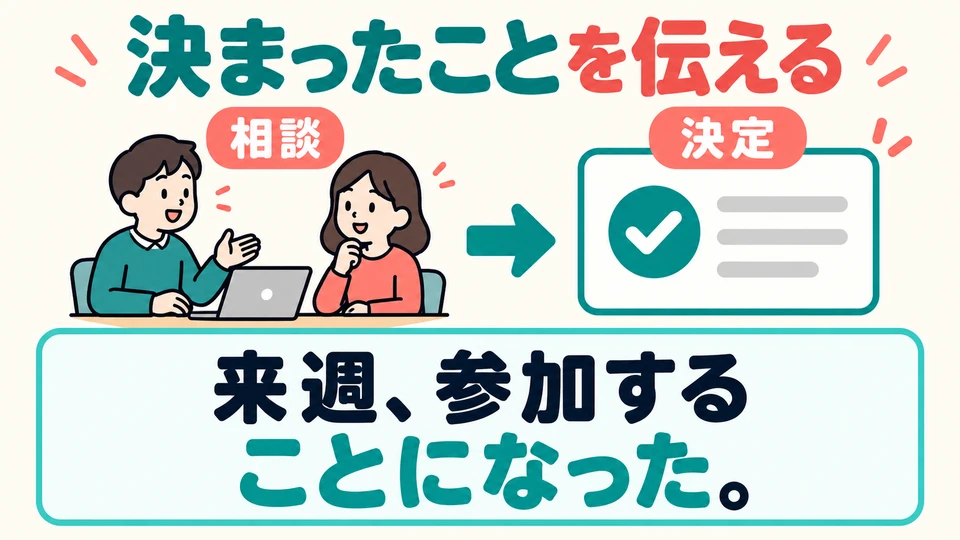
  2. It means something has already been decided or arranged. The focus is on the outcome, without emphasizing who decided.
    It means something has already been decided or arranged. The focus is on the outcome, without emphasizing who decided.

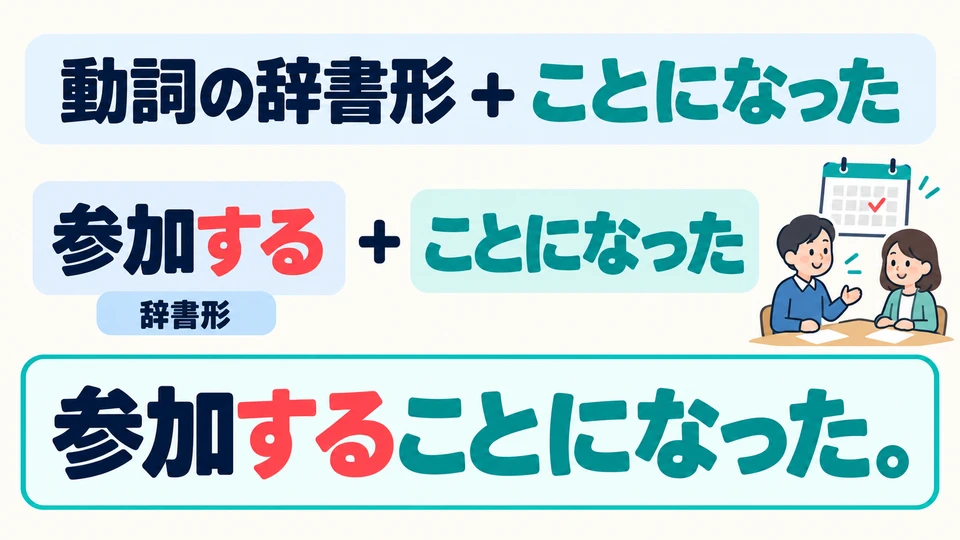
  3. For a decision to do something, use the verb’s dictionary form before it, as in 「参加することになった」.
    For a decision to do something, use the verb’s dictionary form before it, as in 「参加することになった」.

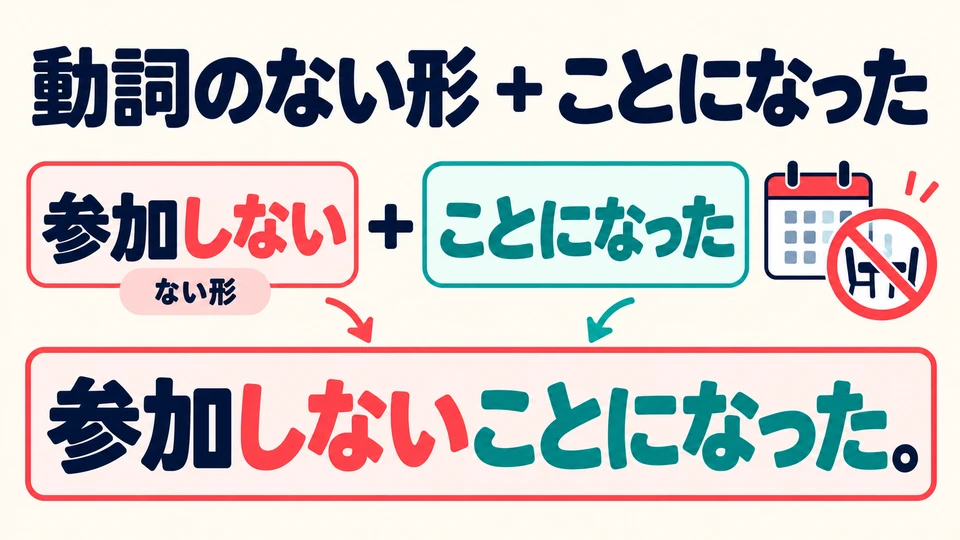
  4. For a decision not to do something, use the verb’s ない-form before it, as in 「参加しないことになった」.

    For a decision not to do something, use the verb’s ない-form before it, as in 「参加しないことになった」.
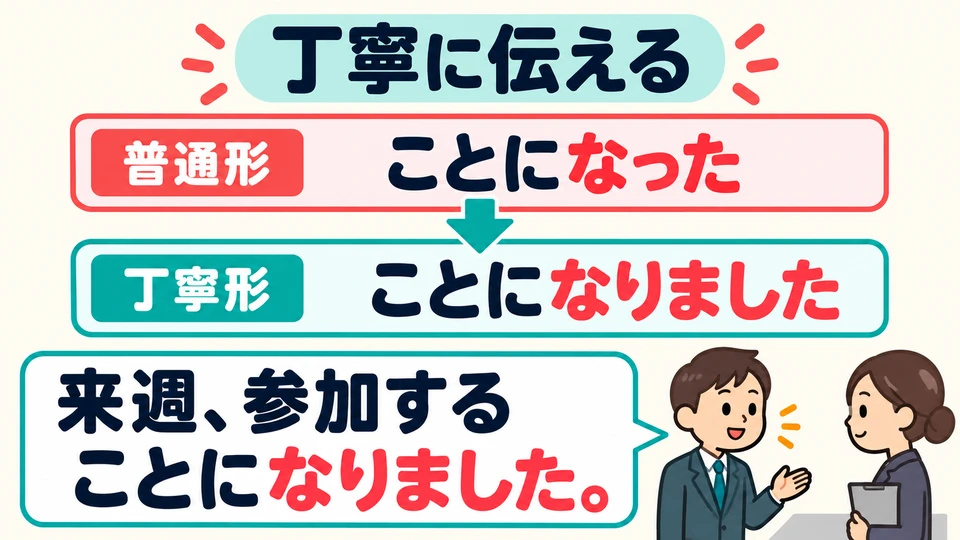
  5. To report an arrangement politely, change 「ことになった」 to 「ことになりました」.
    To report an arrangement politely, change 「ことになった」 to 「ことになりました」.

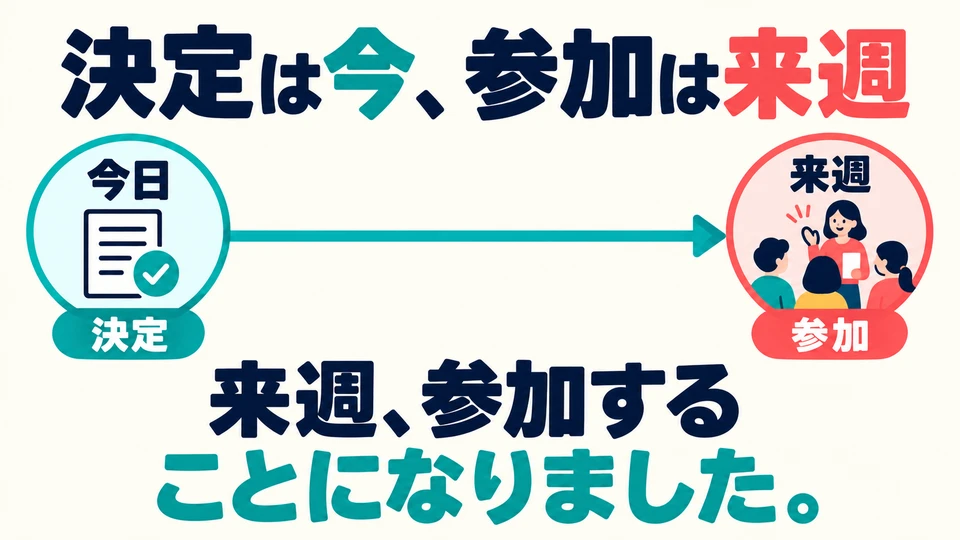
  6. The example says “next week” but uses a past form: the arrangement is already settled, while participation is still next week.
    The example says “next week” but uses a past form: the arrangement is already settled, while participation is still next week.

  7. The reception role was settled after discussion. Here, the speaker reports the outcome of that discussion without emphasizing personal wishes.

    The reception role was settled after discussion. Here, the speaker reports the outcome of that discussion without emphasizing personal wishes.

Example sentences

  • 来週、らいしゅう、raishuu、地域ちいきchiiki交流こうりゅうkouryuu会かいkaiにni参加さんかsankaするsuruことkotoにniなりました。narimashita。

    It has been decided that I will participate in the community exchange meeting next week.

In a conversation

  • 来週らいしゅうのボランティアぼらんてぃあ活動かつどうですが、役割やくわり分担ぶんたんはわ決まりましたきまりましたか。

    Regarding next week's volunteer activity, has the division of roles been decided?

  • はい、私わたし

Check yourself

  1. Level 1 · Recognise

    Which sentence is correct?

  2. Level 1 · Recognise

    Listen and choose the meaning

  3. Level 2 · Build

    Put the words in order

    At the upcoming intergenerational exchange event, I will serve as the facilitator for traditional games.

  4. Level 3 · Use

    What goes in the blank?

    来週、地域交流会に参加____(丁寧な形)。

    It has been decided that I will join the community exchange meeting next week.

More grammar in this theme

  • 〜ことになったit has been decided

More JLPT N4 grammar

Keep practising

Test your Japanese vocabulary12 adaptive questions, freeCheck your pronunciationRead aloud and get a scorePractise verb forms10-question conjugation quizSee the whole courseGrammar, vocabulary and quizzes by theme
  • 主催者しゅさいしゃshusaishaとto相談そうだんsoudanした結果、したけっか、shitakekka、受付うけつけuketsukeのno手伝いてつだいtetsudaiをoするsuruことkotoにniなりました。narimashita。

    As a result of consulting with the organizer, it has been decided that I will help with the reception.

  • はわ
    進行しんこう
    役、やく、
    田中さんたなかさん
    はわ
    記録きろく
    係かかり
    を
    する
    こと
    に
    なりました。

    Yes, it has been decided that I will act as the facilitator and Mr. Tanaka will act as the recorder.

  • 分かりました。わかりました。みんなで協力きょうりょくして頑張りましょう。がんばりましょう。

    I understand. Let's work together and do our best.

  • Intermediate 2
    Intergenerational Exchange and Broader Perspectives
    More quizzesOpen this lesson’s quizzes in the course
    〜どころではないin no position to; far from
    〜たところdid…and found that
    〜に限り/〜限りはlimited to; as long as
    〜かなと思ってthinking maybe; so I
    〜にしてはfor; contrary to expectation
    〜につきper; for each
    〜たものだused to; fond recollection
    〜ながらもalthough; despite feeling
    〜につけ(て)whenever; at every opportunity
    〜さえ/さえ〜ばeven; as long as
    〜に反してcontrary to expectations
    〜ているうちにchange during an activity
    〜からしてinference from a clue
    Previous〜たところ
    Next〜に限り/〜限りは
    See all 138
    〜てしまったようなんですinferred accident with regret
    〜たままleaving a state unchanged
    〜に囲まれている・〜に囲まれたbe surrounded by
    〜のような・〜のようにexamples such as
    人を〜にさせるtrigger someone’s feelings
    〜ば・〜ならばif; on the condition that
    〜たら・〜ためにif; in order to
    〜のようにlike; in the manner of