JPEdLab iconJPEdLab
Save history

Create an account and play

Explore first, then save your progress whenever you are ready. No email address is required.

Start free
  1. Japanese grammar
  2. JLPT N2 grammar
  3. 〜恐れがある

〜恐れがある~ osore ga aru

Osore ga aru (〜恐れがある) means “risk of an unwanted event”.

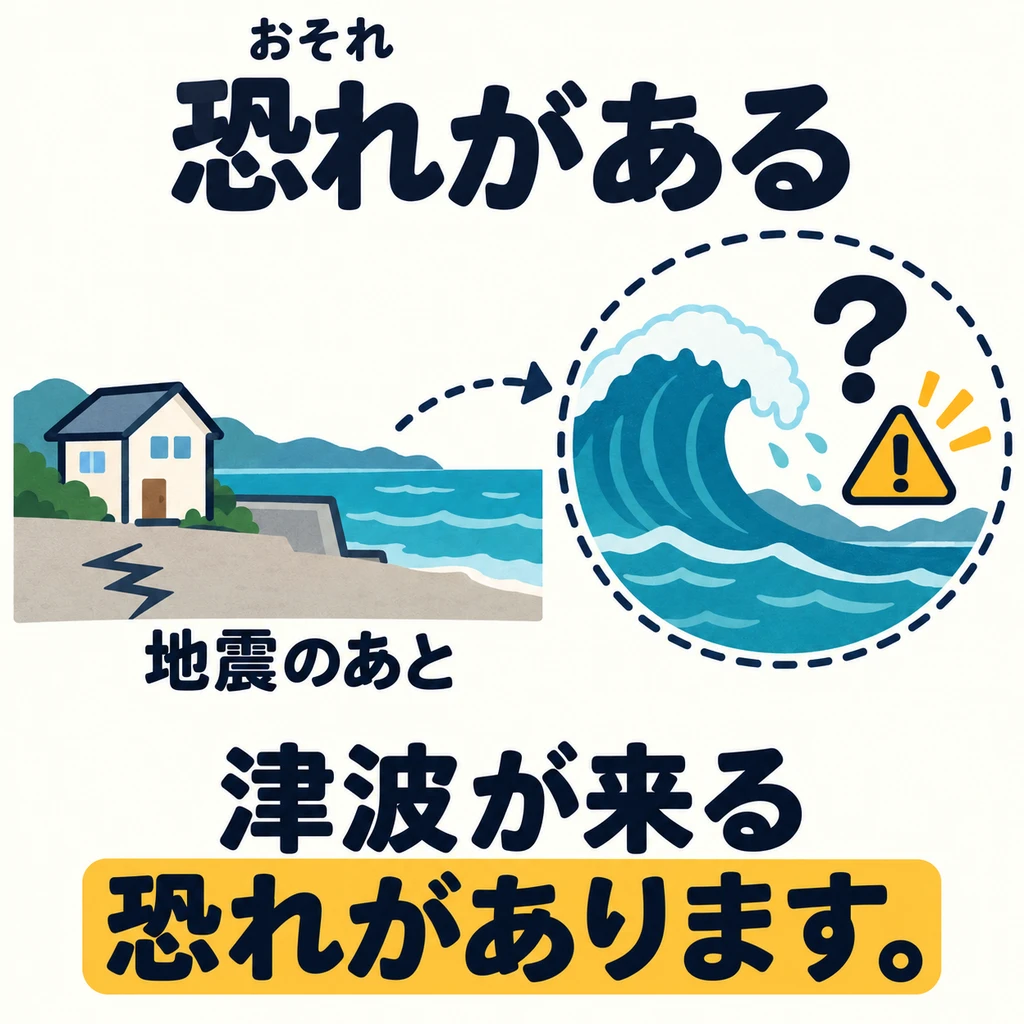
地震じしんjishinのnoあと、ato、津波つなみtsunamiがga来るくるkuru恐れおそれosoreがgaあります。arimasu。

There is a risk that a tsunami may occur after the earthquake.

Use 〜恐れがある in fairly formal warnings about a possible unwanted event, not something hoped for.

In the course›

How it works

  1. Has the tsunami arrived yet? The danger inside the dashed circle has not happened. It warns of what might happen.
    Has the tsunami arrived yet? The danger inside the dashed circle has not happened. It warns of what might happen.

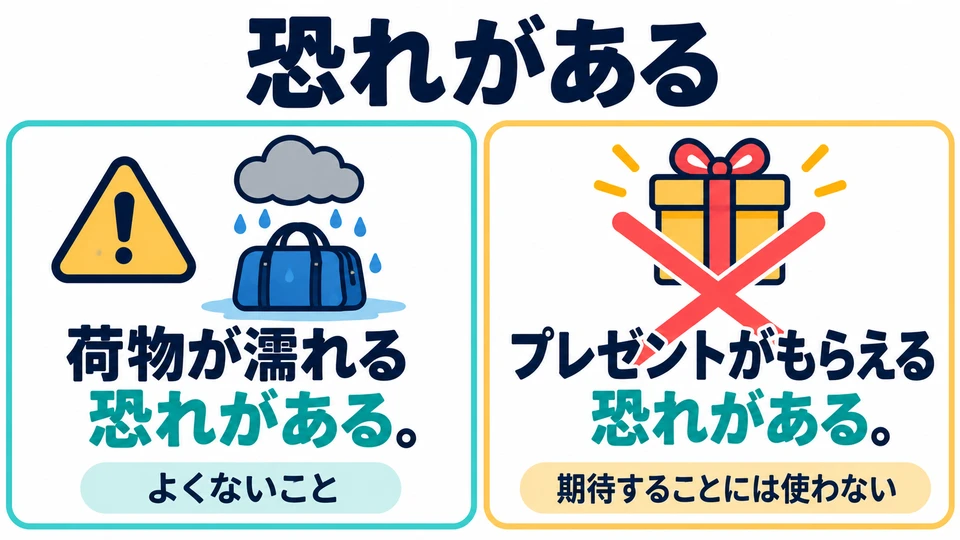
  2. 「恐れがある」 expresses the possibility or risk of something unwanted. Do not use it for good things you hope will happen.
    「恐れがある」 expresses the possibility or risk of something unwanted. Do not use it for good things you hope will happen.

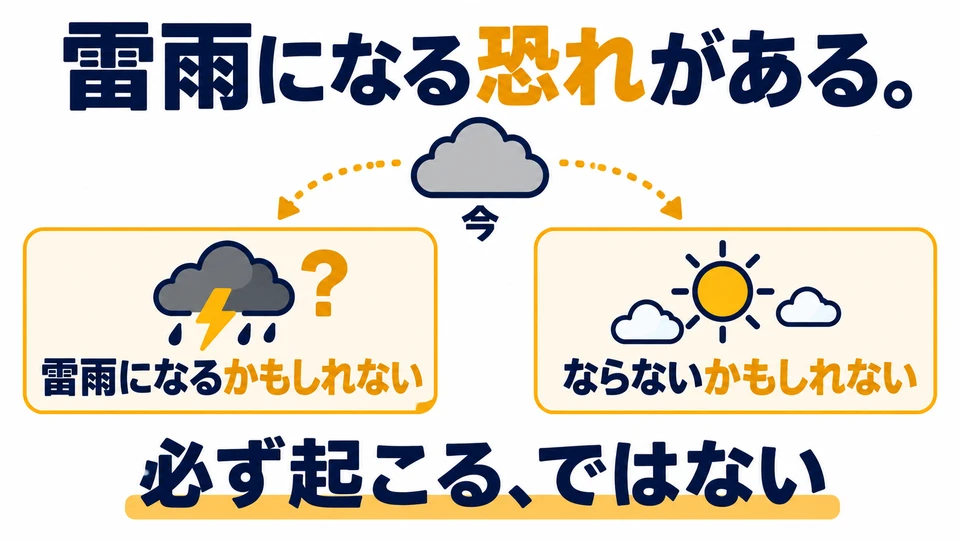
  3. Something being possible does not mean it will definitely happen. Read 「恐れがある」 as a warning about a risk.
    Something being possible does not mean it will definitely happen. Read 「恐れがある」 as a warning about a risk.

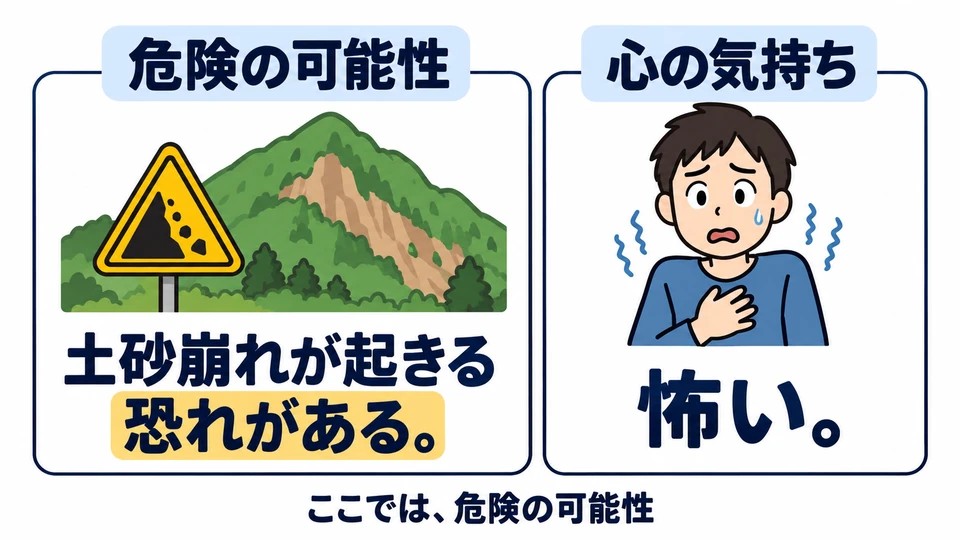
  4. Here, 「恐れ」 means the risk of something bad happening, rather than the fear the speaker feels at that moment.
    Here, 「恐れ」 means the risk of something bad happening, rather than the fear the speaker feels at that moment.

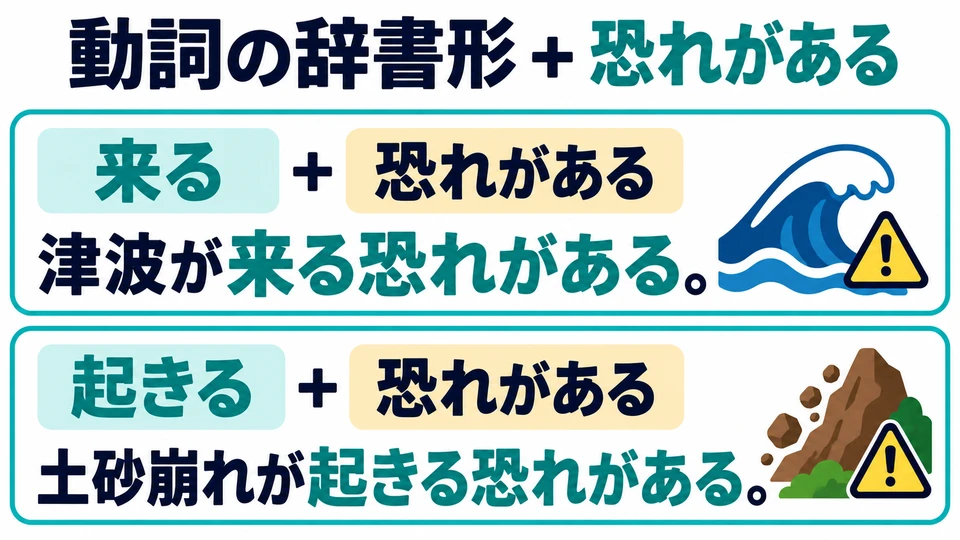
  5. Use a verb’s dictionary form before 「恐れがある」: 来る恐れがある, 起きる恐れがある.
    Use a verb’s dictionary form before 「恐れがある」: 来る恐れがある, 起きる恐れがある.

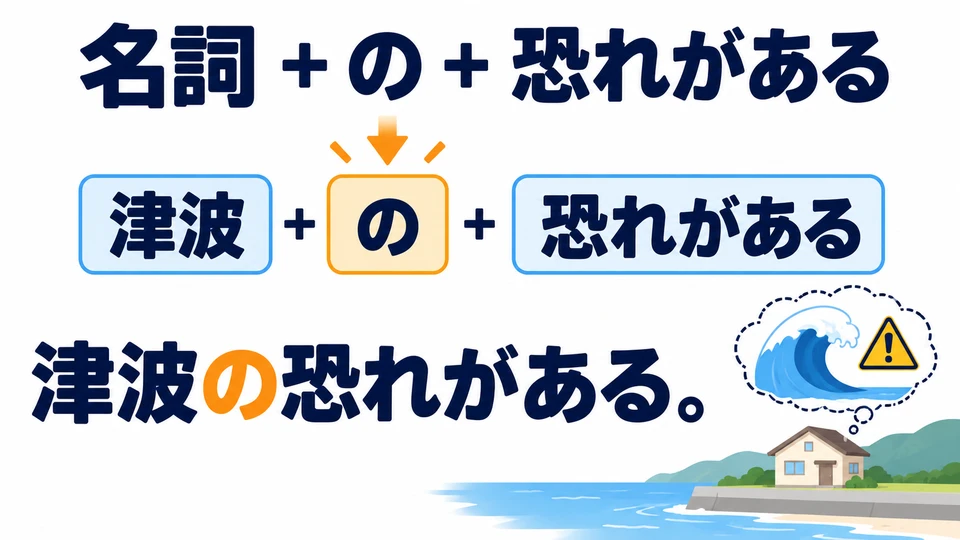
  6. Add 「の」 after a noun: 津波の恐れがある. The noun directly names the danger that might occur.
    Add 「の」 after a noun: 津波の恐れがある. The noun directly names the danger that might occur.

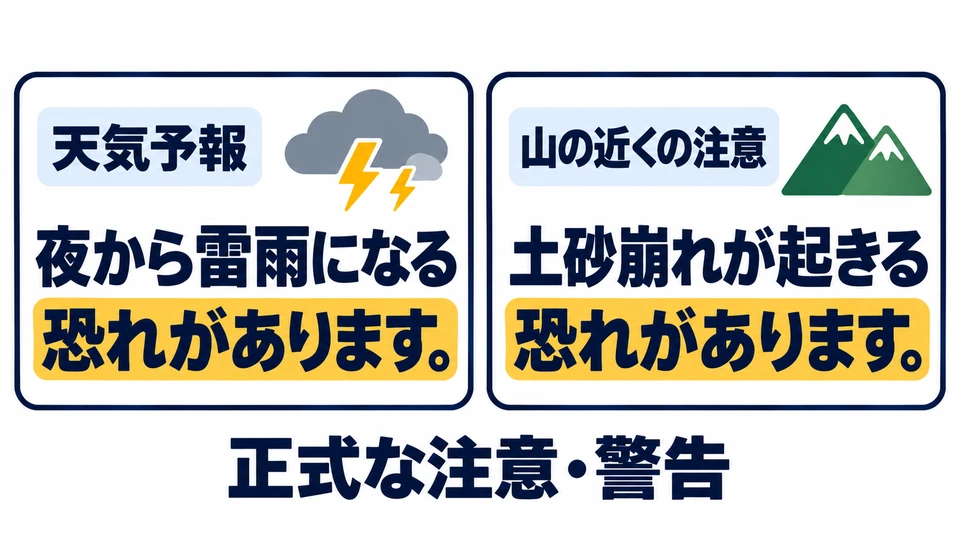
  7. Weather forecasts warn of thunderstorms, and notices in mountain areas warn of landslides. This expression is common in fairly formal warnings.
    Weather forecasts warn of thunderstorms, and notices in mountain areas warn of landslides. This expression is common in fairly formal warnings.

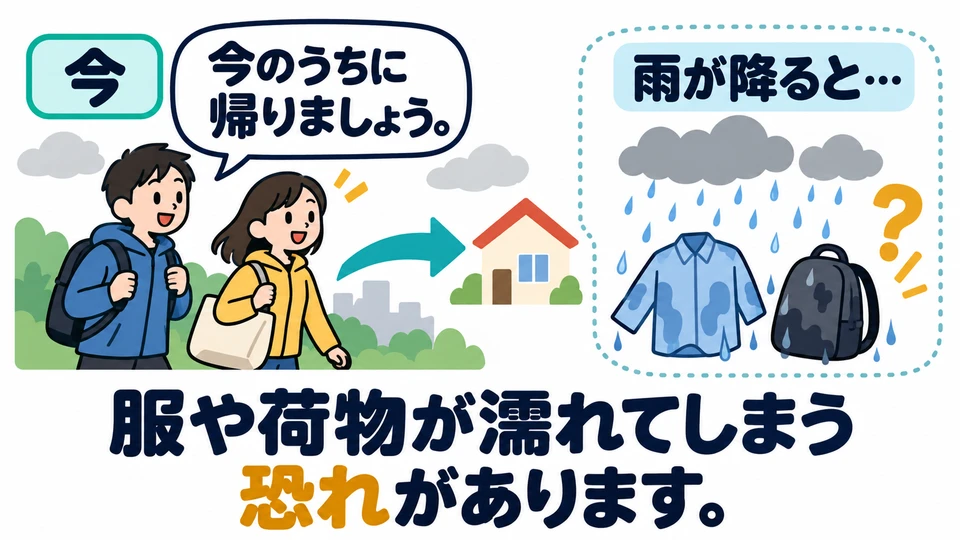
  8. In conversation, concern about clothes and luggage getting wet can prompt a warning to go home early, before it rains, to prevent damage.

    In conversation, concern about clothes and luggage getting wet can prompt a warning to go home early, before it rains, to prevent damage.

Example sentences

  • 地震じしんjishinのnoあと、ato、津波つなみtsunamiがga来るくるkuru恐れおそれosoreがgaあります。arimasu。

    There is a risk that a tsunami may occur after the earthquake.

  • 山

In a conversation

  • A
    天気てんき予報よほうによると、夜よるから急きゅうに雷雨にらいうになる恐れおそれがあるそうですよ。

    A: According to the weather forecast, there is a risk of sudden thunderstorms starting tonight.

Check yourself

  1. Level 1 · Recognise

    Which sentence is correct?

  2. Level 1 · Recognise

    Listen and choose the meaning

  3. Level 2 · Build

    Put the words in order

    After heavy rain, there is a risk of landslides occurring.

  4. Level 3 · Use

    What goes in the blank?

    地震のあと、津波が来る____があります。

    There is a risk of a tsunami coming after an earthquake.

More grammar in this theme

  • 〜恐れがあるrisk of an unwanted event

More JLPT N2 grammar

Keep practising

Test your Japanese vocabulary12 adaptive questions, freeCheck your pronunciationRead aloud and get a scorePractise verb forms10-question conjugation quizSee the whole courseGrammar, vocabulary and quizzes by theme
やま
yama
のno
近くちかくchikaku
でde
は、わ、wa、
土砂崩れどしゃくずれdoshakuzure
がga
起きるおきるokiru
恐れおそれosore
がga
あります。arimasu。

Near the mountains, there is a risk that landslides may occur.

  • B
    本当ほんとうですか。早くはやく帰らないかえらないと、激しいはげしい雨あめで服ふくや荷物にもつが濡れぬれてしまう恐れおそれがありますね。

    B: Really? If I don't go home early, my clothes and luggage might get wet from the heavy rain.

  • A
    はい、折りたたみおりたたみ傘がさを持っもっていないので、今いまのうちに帰りましょう。かえりましょう。

    A: Yes, since I don't have a folding umbrella, let's head home while we still can.

  • Intermediate 2
    Emergencies and Safety Actions
    More quizzesOpen this lesson’s quizzes in the course
    〜によって/〜により/〜による〜cause and resulting effect
    〜そうにないんですがunlikely; gently explain difficulty
    〜とかでpossible cause, or something
    〜てしまったようなんですinferred accident with regret
    〜ところへ・に・をan event at that moment
    〜につれてgradual changes happening together
    〜ものだ・〜ものではないwhat one should or should not do
    〜とおりに・〜どおりにaccording to; just as
    〜際に・〜際はon the occasion of
    〜ことformal rule or instruction
    〜たままleaving a state unchanged
    〜だらけcovered with many unwanted things
    Previous〜によって/〜により/〜による〜
    Next〜そうにないんですが
    See all 55
    〜にかかわらずregardless of a condition
    〜次第/〜次第でdepending on; as soon as
    〜を背にしてwith something behind you
    〜に沿って・〜に沿う・〜に沿ったalong; in accordance with
    〜が〜を占める・〜が占めるaccount for a share
    〜に備えてin preparation for
    〜に限るnothing beats
    〜どころではないin no position to; far from