JPEdLab iconJPEdLab
Save history

Create an account and play

Explore first, then save your progress whenever you are ready. No email address is required.

Start free
  1. Japanese grammar
  2. JLPT N3 grammar
  3. 〜た上で

〜た上で~ta ue de

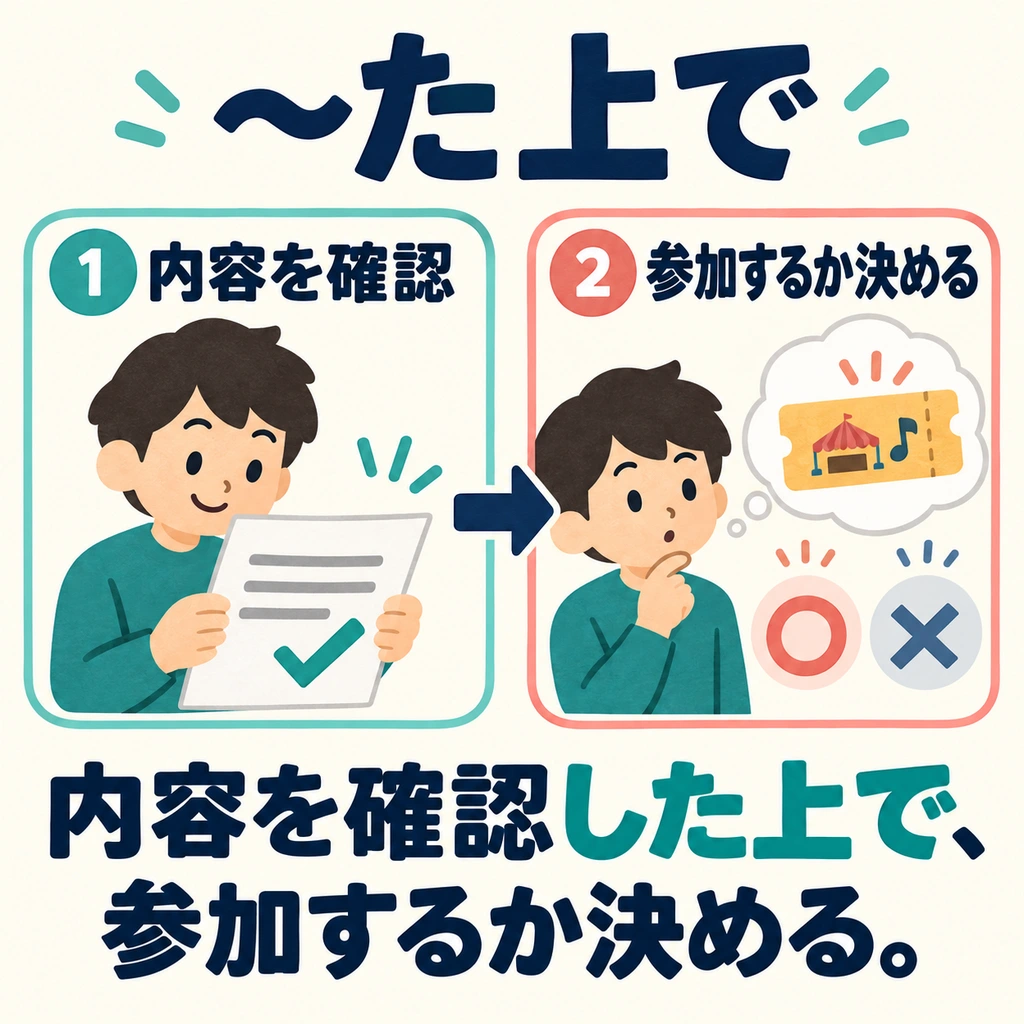
Ta ue de (〜た上で) means “complete a step before deciding”.

内容ないようnaiyouをo確認かくにんkakuninした上したうえshitaueで、de、参加さんかsankaするsuruかkaどうdouかka決めきめkimeてteください。kudasai。

Please decide whether or not to participate after confirming the details.

Use 〜た上で when a necessary step must be completed before you make the following decision or take action.

In the course›

How it works

  1. To decide whether to join the event, first check the details, then make your decision. Notice the order in the picture.
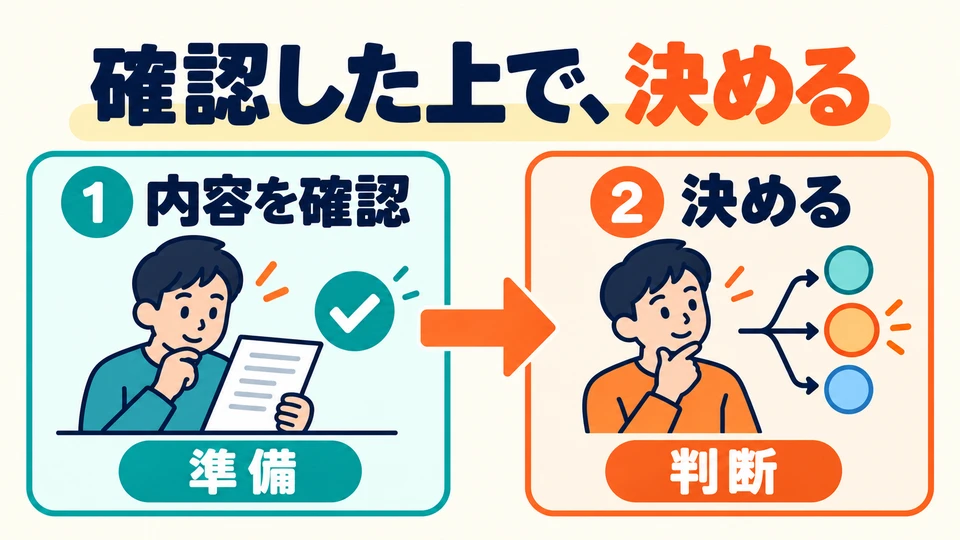
    To decide whether to join the event, first check the details, then make your decision. Notice the order in the picture.

  2. The check prepares you for the decision that follows. The emphasis is on completing a necessary step first, rather than just listing actions in order.
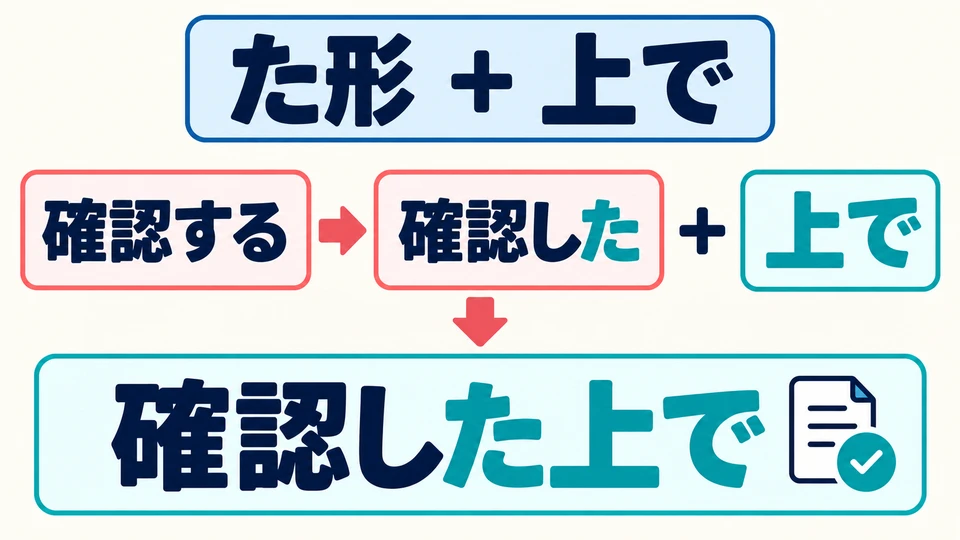
    The check prepares you for the decision that follows. The emphasis is on completing a necessary step first, rather than just listing actions in order.

  3. Use the verb’s た-form + 上で. For example, 「確認する」 becomes 「確認した上で」.
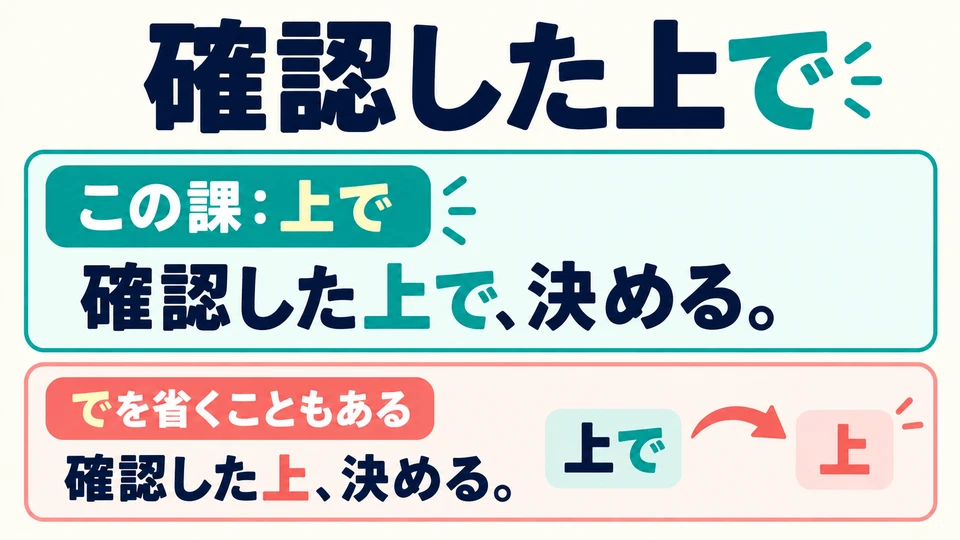
    Use the verb’s た-form + 上で. For example, 「確認する」 becomes 「確認した上で」.

  4. The 「で」 after 「上」 can sometimes be omitted. In this lesson, first learn 「上で」 as used in the example.
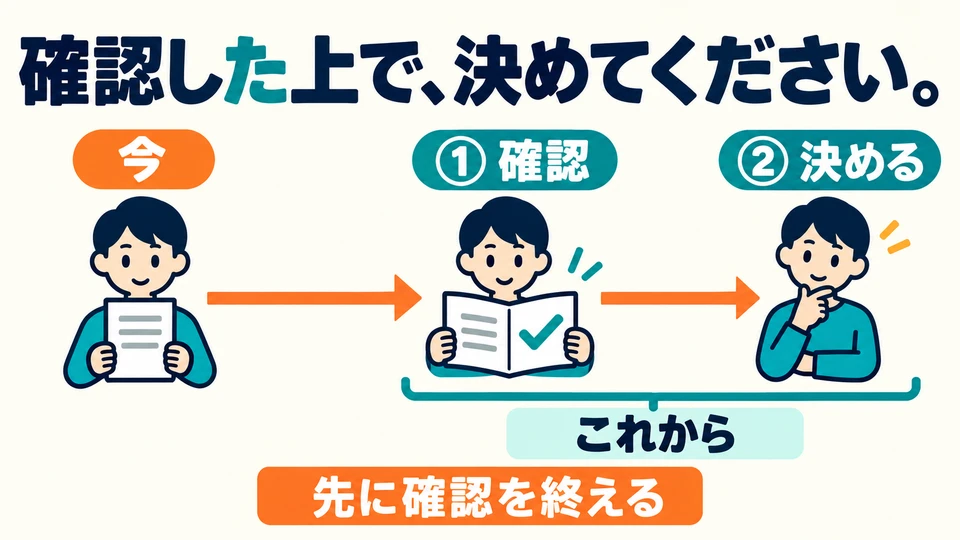
    The 「で」 after 「上」 can sometimes be omitted. In this lesson, first learn 「上で」 as used in the example.

  5. The example gives guidance for what to do next. 「た」 means the check must be completed first; it does not say the check has already happened.
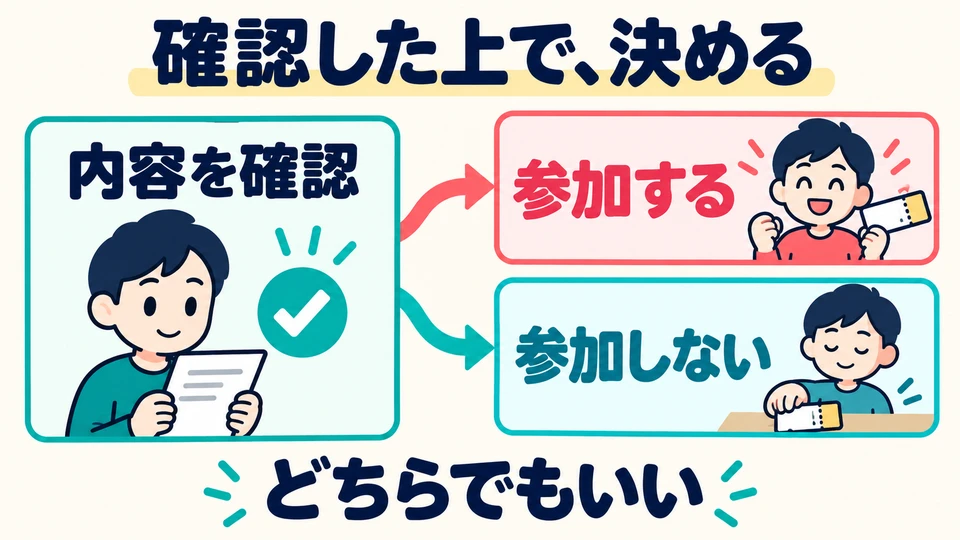
    The example gives guidance for what to do next. 「た」 means the check must be completed first; it does not say the check has already happened.

  6. After checking, decide whether to participate. You can also decide not to join; checking does not mean agreeing to take part.

    After checking, decide whether to participate. You can also decide not to join; checking does not mean agreeing to take part.

Example sentences

  • 内容ないようnaiyouをo確認かくにんkakuninした上したうえshitaueで、de、参加さんかsankaするsuruかkaどうdouかka決めきめkimeてte

In a conversation

  • A
    このイベントいべんとの服装ふくそうは、わ、スーツすーつを着たほうきたほうがいいですか。

    A: Should I wear a suit for this event?

  • B
    案内あんない文ぶんに

Check yourself

  1. Level 1 · Recognise

    Which sentence is correct?

  2. Level 1 · Recognise

    Listen and choose the meaning

  3. Level 2 · Build

    Put the words in order

    Please apply after reading the application guidelines.

  4. Level 3 · Use

    What goes in the blank?

    内容を確認した____、参加するかどうか決めてください。

    After confirming the details, please decide whether to participate.

More grammar in this theme

  • 〜た上でcomplete a step before deciding

More JLPT N3 grammar

Keep practising

Test your Japanese vocabulary12 adaptive questions, freeCheck your pronunciationRead aloud and get a scorePractise verb forms10-question conjugation quizSee the whole courseGrammar, vocabulary and quizzes by theme
ください。kudasai。

Please decide whether or not to participate after confirming the details.

書いかい
て
ある
服装ふくそう
を
確認かくにん
した上したうえ
で、
決めきめ
て
ください。

B: Please decide after checking the dress code written in the information sheet.

  • A
    わかりました。家いえでもう一度いちど読んよんでみます。

    A: I see. I will try reading it again at home.

  • Intermediate 1
    New Environments and Self-Introduction
    More quizzesOpen this lesson’s quizzes in the course
    〜において・〜におけるformal setting or field
    〜上でconditions for doing something
    〜てほしいwant someone to do
    〜てもらいたいwant to receive someone’s help
    〜よねseek agreement or confirmation
    〜とか〜とかexamples among other things
    〜だけ・〜だけのonly; just enough for
    〜でしょう・〜だろうlikely; probably
    〜から〜にかけてapproximate time or place range
    〜とcondition and natural result
    〜がきっかけでtrigger for a change
    〜っぽいcharacteristic or impression
    〜でもeven in a situation
    Previous〜上で
    Next〜てほしい
    See all 114
    〜んだってcasual hearsay
    〜だけじゃなくて、〜もnot only A but also B
    〜てきましたchange continuing until now
    〜ためにcause: because of
    〜によってvaries depending on
    〜のうちにbefore a state changes
    〜のわりにsurprisingly, considering
    〜がいいんじゃないgentle suggestion or advice